5 Early Computer Viruses That Shaped the History of Malware
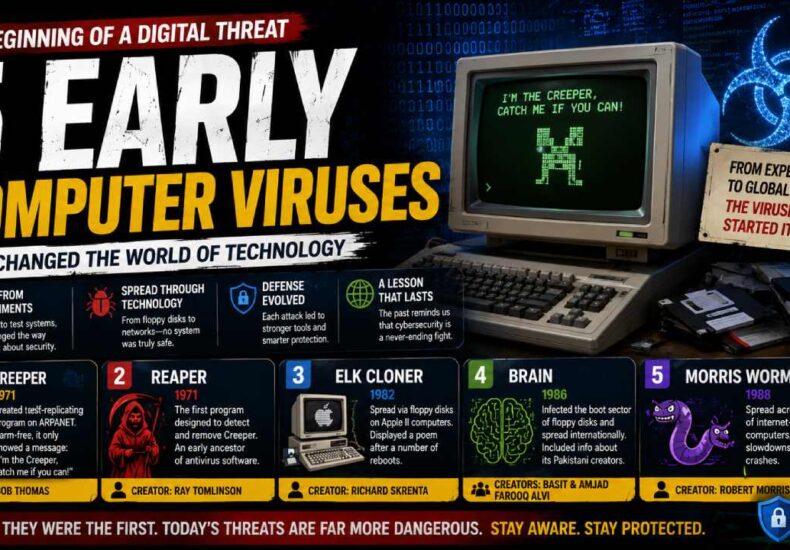
Fundacion Rapala – The story of First Computer Viruses History began with Creeper in 1971. Computer scientist Bob Thomas created the program while working at BBN Technologies. At the time, researchers were testing ARPANET, an early network that helped shape the modern internet. Thomas wanted to discover whether software could move between connected computers by itself. Creeper proved that idea could work. It traveled across compatible systems and displayed a playful message on the screen. However, the program did not steal information, destroy files, or demand money from users. Instead, it served as a technical experiment. Even so, Creeper introduced an idea that later became important in cybersecurity. Software could travel between connected machines without following the usual installation process. Therefore, this simple experiment helped researchers understand both the possibilities and risks of connected computer networks.
Reaper Introduced an Early Form of Digital Defense
Soon after Creeper appeared, another program called Reaper entered the story. Ray Tomlinson developed Reaper to locate Creeper and remove it from affected computers. As a result, many technology historians describe Reaper as an early example of antivirus software. Its purpose was simple, yet the idea behind it became extremely important. A computer program could search for unwanted software and remove it automatically. Moreover, the relationship between Creeper and Reaper introduced a pattern that remains familiar today. New digital threats often encourage developers to create stronger security tools. Modern antivirus programs now use advanced scanning systems, threat databases, and behavior analysis. Reaper had none of those complex features. Still, its basic mission feels surprisingly familiar. It searched for a specific program and removed it. Therefore, Reaper helped establish an early foundation for the digital defense systems that protect computers today.
Read More : ChatGPT Free Gets Smarter as OpenAI Expands Access to GPT-5.6 Luna
Elk Cloner Carried Viruses Into Personal Computers
In 1982, Elk Cloner showed that unwanted software could spread beyond research networks. Richard Skrenta created the program as a teenager, and it targeted Apple II computers. Unlike Creeper, Elk Cloner traveled through floppy disks. At that time, people regularly used disks to exchange games, programs, and personal files. This habit gave the program an easy path between computers. After someone started a computer with an infected disk, Elk Cloner entered the system’s memory. It could then copy itself onto other disks. Eventually, users saw a short poem appear on their screens. The program caused more surprise than serious destruction. However, it revealed an important security problem. People could unknowingly carry unwanted software from one machine to another. Consequently, Elk Cloner showed that human behavior could help computer viruses spread. That lesson still matters in an age of downloads, email attachments, and portable storage.
Brain Showed How Viruses Could Travel Worldwide
Brain appeared in 1986 and became another major chapter in First Computer Viruses History. Pakistani brothers Basit Farooq Alvi and Amjad Farooq Alvi created the program. Brain targeted IBM-compatible personal computers and spread through infected floppy disks. When users shared those disks, the virus could reach new machines. Interestingly, Brain included contact information connected to its creators. Reports about its origins often describe it as an attempt to discourage unauthorized software copying. However, the program eventually traveled much farther than expected. Infected disks moved between users and crossed international borders. Therefore, Brain demonstrated how quickly software could escape its original environment once people started sharing infected media. Personal computers were also becoming more common during this period. That growth created more opportunities for viruses to spread. Brain consequently became an important reminder that digital threats could develop into international problems rather than remain isolated technical experiments.
Read More :Google Cancels AI Studio Mobile App Despite 800,000 Pre-Orders, Shifts Features to Gemini
The Morris Worm Revealed the Risks of Connected Networks
The Morris Worm created widespread disruption in 1988. Robert Tappan Morris, then a graduate student, developed the program to explore connected computer systems. However, the worm spread far more aggressively than intended. It used several techniques to move across machines connected to the early internet. Some computers received multiple copies of the worm, which consumed resources and slowed their systems. Consequently, thousands of machines experienced serious performance problems. The incident attracted major attention because universities and research institutions increasingly depended on networked computers. More importantly, the Morris Worm showed how rapidly software could spread when many systems shared connections. The event also produced legal consequences for Morris. Meanwhile, security experts began paying greater attention to weaknesses in connected networks. Today, the internet links billions of devices. Therefore, the lesson from 1988 remains relevant: one software flaw can create problems far beyond a single computer.
Jerusalem Showed the Destructive Side of Computer Viruses
Jerusalem, discovered in 1987, showed that computer viruses could cause more than inconvenience. The virus targeted DOS-based computers and spread when users ran infected programs. Unlike harmless experiments such as Creeper, Jerusalem could interfere with computer operations and damage executable files under certain conditions. It also became famous for behavior linked to specific calendar dates. As a result, users began paying more attention to viruses that activated after a particular trigger. Researchers never established its creator with complete certainty. Nevertheless, Jerusalem became an important example of increasingly harmful malware. Computers were entering more homes and workplaces during this period. People also stored more valuable documents and business information on them. Therefore, destructive viruses created growing financial and operational risks. Jerusalem helped change public perception of malware. A computer virus was no longer simply a strange technical experiment. Instead, it could threaten important files and interrupt everyday work.
Early Computer Viruses Left Lessons That Still Matter
These early programs reveal how computer security evolved alongside digital technology. Creeper demonstrated that software could travel across a network. Reaper introduced an early method for removing unwanted code. Meanwhile, Elk Cloner showed how people could spread viruses through removable media. Brain demonstrated that infections could cross international borders, while the Morris Worm exposed the risks of connected networks. Jerusalem then highlighted the potential for direct file damage. Although these programs differed greatly, each one taught researchers something important about digital security. Modern cyber threats have become far more advanced. Criminal groups now use ransomware, spyware, credential theft, and other techniques to target individuals and organizations. However, several basic risks remain familiar. Malware still exploits weaknesses, connections, and human mistakes. Therefore, studying these early viruses offers more than an interesting history lesson. It explains why cybersecurity remains essential wherever people store, share, or access valuable digital information.