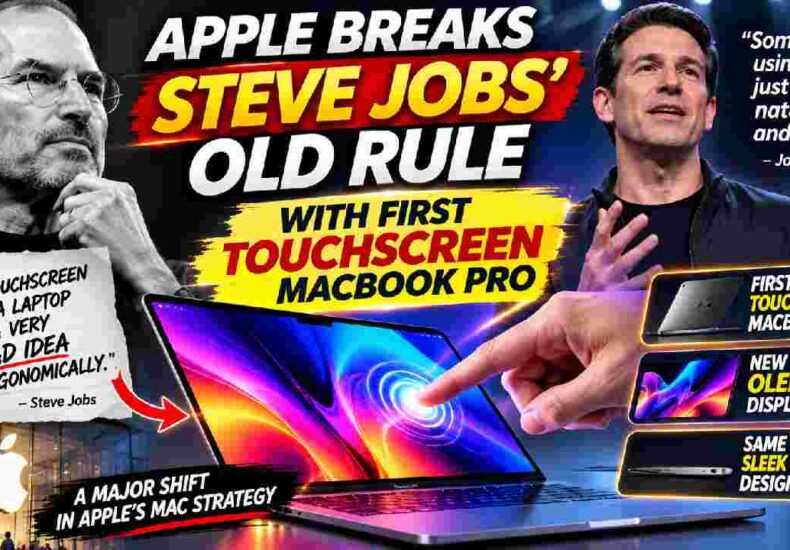
Apple Breaks Steve Jobs’ Old Rule With First Touchscreen MacBook Pro
Fndacion Rapala – For more than a decade, the idea of an Apple Touchscreen MacBook Pro seemed almost impossible. Apple had consistently kept touch controls away from its Mac lineup, even as competing laptop makers embraced the technology. That long-standing philosophy has now changed. Apple has introduced new 14-inch and 16-inch MacBook Pro models featuring the PROLED XDR Display, bringing touchscreen interaction to the MacBook for the first time. The display also marks another important shift because Apple has adopted OLED technology for its professional laptop lineup. Together, these changes represent more than a routine hardware upgrade. They show how Apple is reconsidering assumptions that shaped the Mac experience for years. However, the company has not abandoned traditional controls. The keyboard and trackpad remain central to the MacBook experience, while touch becomes an additional option when direct interaction feels faster, easier, or simply more natural.
Read More : China Develops Laser Internet to Connect Future Humans on the Moon
Steve Jobs Once Strongly Rejected Touchscreen Laptops
The launch carries historical weight because Steve Jobs once openly rejected the idea of putting touchscreens on laptops. During a MacBook presentation more than 16 years ago, Apple’s late co-founder argued that vertical touch surfaces created poor ergonomics. His concern was straightforward. Users would need to repeatedly lift their arms toward an upright display, which could quickly become uncomfortable. Jobs believed touch interfaces worked better on devices held naturally in the hands rather than on conventional notebook screens. That argument influenced Apple’s product philosophy for years. While the iPhone and iPad developed around touch interaction, MacBooks continued relying on keyboards, trackpads, and pointer-based navigation. Therefore, Apple’s latest decision feels especially significant. Technology has changed dramatically since Jobs made those comments, but the basic human interaction challenge remains relevant. Apple now believes it can add touchscreen functionality without sacrificing the comfort, portability, and familiar experience that Mac users expect.
John Ternus Leads Apple Into a Different Design Era
Under CEO John Ternus, Apple appears willing to reconsider product rules that once seemed permanent. In an interview with WIRED cited in the source material, Ternus acknowledged the significance of bringing touchscreen technology to the Mac. His response suggested that Apple sees the change less as abandoning its history and more as adapting to new possibilities. Importantly, Ternus stressed that users are not expected to replace the keyboard and trackpad with constant touchscreen interaction. Instead, Apple sees touch as another tool available for moments when reaching directly toward the display feels convenient. That distinction matters because it addresses the ergonomic concern Steve Jobs raised years earlier. Apple is not attempting to transform the MacBook into an oversized tablet. Rather, the company appears to be expanding the ways people can interact with professional software. The strategy reflects a familiar Apple approach: wait until the company believes the technology can improve an experience without introducing unacceptable compromises.
Read More :OpenAI Launches GPT-6.1 Terra, Bringing Faster and Cheaper Computer Use to AI
OLED Technology Helps Make the Change Possible
Apple’s decision also reflects advances in display technology. According to Ternus, the company did not want touchscreen hardware to make the MacBook Pro noticeably thicker or heavier. That requirement presented an engineering challenge because adding new display capabilities can introduce extra components and design compromises. OLED technology helped create an opportunity to rethink that equation. The new PROLED XDR Display combines touch interaction with the visual advantages associated with modern OLED panels. For professional users, that could make the screen more useful for creative workflows while maintaining the portable character expected from a MacBook Pro. More importantly, Apple appears to have waited until it believed the technology could meet its own design standards. The company has often entered established product categories later than competitors. In this case, the delay allowed Apple to preserve its familiar laptop format while introducing a feature that would have seemed inconsistent with the Mac philosophy only several years ago.
Touch Adds Another Option Without Replacing the Trackpad
The biggest question is how people will actually use touch on a MacBook. Apple still views the keyboard and trackpad as the primary controls, which means the touchscreen serves as a complementary interface rather than a complete replacement. That approach could prove useful in everyday situations. Users may find it quicker to tap a button, navigate visual content, adjust creative elements, or interact directly with certain applications. At the same time, traditional controls remain available for precise tasks that benefit from a pointer and physical keyboard. This hybrid approach may help Apple avoid the ergonomic problems that once worried Steve Jobs. Users do not need to keep their arms raised for extended periods. Instead, they can touch the display only when the interaction makes sense. Ultimately, the value of the feature will depend on software support and user habits. If developers embrace direct touch thoughtfully, Mac workflows could become more flexible without losing their familiar identity.
The New MacBook Shows How Apple Can Change Its Mind
Technology companies often build strong identities around certain design principles, yet those principles cannot remain frozen forever. Apple’s touchscreen MacBook illustrates how dramatically circumstances can change as hardware improves and user behavior evolves. Steve Jobs’ original objection reflected the laptop technology and interface expectations of his era. More than 16 years later, displays are thinner, software is more flexible, and consumers have spent years switching between touchscreens and traditional computers. Apple now appears confident that those worlds can coexist inside one MacBook without forcing users to choose between them. Still, the company faces an important test. Adding touch must deliver practical value rather than becoming a headline feature that people rarely use. If Apple succeeds, the change could influence future Mac models and application design. More broadly, it demonstrates that even one of Apple’s most recognizable product philosophies can evolve when technology creates a convincing reason to reconsider it.
A Once-Rejected Idea Now Opens a New Chapter for Mac
There is something symbolic about seeing Apple introduce a feature that its legendary co-founder once dismissed. Yet innovation often involves revisiting old assumptions rather than simply following them forever. The new touchscreen MacBook Pro captures that tension between heritage and change. Apple still protects many elements that define the Mac, including its keyboard-driven productivity and trackpad precision. However, the company is now allowing users to reach forward and interact directly with the display when that feels more efficient. The decision could mark the beginning of a broader transformation across Apple’s computer lineup. Future software may increasingly combine pointer controls, gestures, and direct touch in ways that once belonged to separate device categories. For longtime Apple followers, the shift offers an intriguing reminder that product philosophy is not permanent. Steve Jobs helped define what the Mac should be for his generation. Now Apple is testing what the Mac can become for the next one.