Kimi K3.1 Pro Launches With AI Scores Close to Claude Opus 5.5
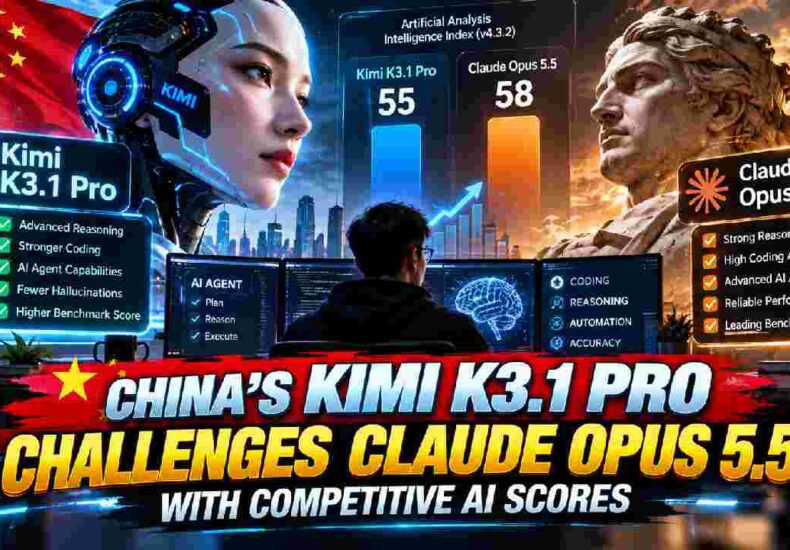
Fundacion Rapala – Chinese artificial intelligence company Moonshot AI has introduced Kimi K3.1 Pro, a new model designed for complex reasoning, coding, and automated tasks. The launch puts fresh attention on China’s fast-growing AI industry. More importantly, early benchmark results suggest the model can compete with some leading global systems. Kimi K3.1 Pro scored 55 points on version 4.3.2 of the Artificial Analysis Intelligence Index. Claude Opus 5.5 scored 58 points in the same index. The three-point difference places the two models relatively close in this specific benchmark. Meanwhile, Kimi K3.1 Pro AI improved by 11 points over the earlier Kimi K3 model. That jump shows how quickly Moonshot AI has developed its technology. Still, benchmark results only measure selected tasks. They cannot prove that one AI model will perform better in every real-world situation or for every type of user.
Agentic AI Skills Receive a Major Upgrade
One of the most notable improvements appears in tasks that require several steps. Instead of only answering a question, Kimi K3.1 Pro can work through a sequence of actions to complete a larger goal. This ability is often associated with AI agents. Terminal-Bench 4.0 tested this capability by asking models to complete technical tasks through a computer terminal. These tasks can include programming and system operations. Kimi K3.1 Pro recorded a score of 65.7 percent. Claude Opus 5.5 remained slightly ahead with 66.4 percent. The reported result also placed Kimi above GPT-6 Astra, which scored 58.2 percent in that test. However, the difference should not become a simple ranking of overall coding quality. Terminal-Bench measures a specific set of technical skills. Real coding work also depends on reliability, context, tools, project size, and the developer’s own workflow.
Coding Performance Shows a Dramatic Generational Jump
The comparison with Kimi K3 makes the latest result particularly striking. According to the reported Terminal-Bench 4.0 results, Kimi K3 scored only 13 percent. Its successor reached 65.7 percent. This large increase suggests Moonshot AI focused heavily on technical task execution when developing the new model. For programmers, stronger terminal performance could make an AI assistant more useful for debugging, managing files, running commands, and completing multi-step development work. However, developers should still review AI-generated commands and code before using them in important systems. A strong benchmark score cannot remove the risk of incorrect output. The model can still misunderstand instructions or generate flawed solutions. Therefore, Kimi K3.1 Pro AI may become a more capable coding partner, but human oversight remains important. Its biggest achievement may be the speed of improvement rather than any claim that it has already become the best coding model.
Read More : AI Exposes PHP Security Flaws, Revealing a Global Web Risk
Professional Tasks Put Kimi Close to Major Rivals
Moonshot AI also tested its latest model on work that resembles professional tasks. In GDPval-AA, Kimi K3.1 Pro achieved an Elo score of 1,846 points. That represented a 312-point improvement over Kimi K3. The result also brought the model close to several competitors in the reported comparison. Claude Opus 5.5 reached 1,866 points, while Meta Muse Wonder Full recorded 1,857 points. These numbers suggest that Moonshot AI is trying to move Kimi beyond general chatbot conversations. The company wants its model to handle practical work that requires planning, reasoning, and execution. Such capabilities matter as businesses increasingly explore AI for research, software development, document processing, and other professional workflows. Still, companies should test models using their own tasks before adopting them. Benchmarks provide useful comparisons, but workplace performance can change depending on prompts, tools, data, language, and the complexity of each assignment.
Moonshot AI Claims Fewer Hallucinations
Accuracy remains one of the biggest challenges facing generative AI. A model can produce an answer that sounds confident while including false information. The industry commonly describes this behavior as hallucination. Moonshot AI says it has reduced this problem in Kimi K3.1 Pro. According to the company’s internal Kimi Hallu Bench Hard test, the rate of incorrect claims fell from 23.4 percent on Kimi K3 to 8.3 percent on the newer model. If that improvement carries over to everyday use, it could make Kimi K3.1 Pro AI more dependable for tasks that require factual answers. However, users should interpret internal benchmark results carefully. An internal test does not guarantee perfect accuracy across every topic or language. AI systems can still make mistakes, especially when information is unclear or missing. Users should therefore verify important claims through reliable sources, particularly when working with medical, legal, financial, or other high-impact information.
Read More :Critical PHP2Shell Flaws Force Government Websites Offline Worldwide
Benchmark Scores Reveal Progress but Not a Universal Winner
The latest numbers make Kimi K3.1 Pro look competitive, but AI benchmarks require careful interpretation. Each test measures different abilities under specific conditions. Artificial Analysis provides a broader intelligence index, while Terminal-Bench focuses heavily on terminal-based technical tasks. GDPval-AA examines professional work from another angle. As a result, a model can perform strongly on one benchmark and less impressively on another. Speed, price, context limits, tool support, accuracy, and user experience also influence the value of an AI system. These factors may matter more than a small score difference for many users. Therefore, saying Kimi K3.1 Pro is universally better than another model would go beyond the available evidence. What the results do show is meaningful progress. Moonshot AI has narrowed the gap in several measured areas. That development adds another serious competitor to an AI market already moving at an unusually fast pace.
Kimi’s Rapid Rise Highlights China’s Growing AI Ambition
Kimi K3.1 Pro represents more than a routine model update for Moonshot AI. Its reported gains show how quickly developers can improve reasoning, coding, and agent-like capabilities between model generations. The jump from Kimi K3 is especially notable because several benchmark results moved sharply upward. At the same time, competition from Claude and other advanced models continues to set a demanding standard. Users ultimately benefit from this rivalry because developers have stronger incentives to improve accuracy, efficiency, and practical features. Yet benchmark competition should not distract from responsible use. Every model still needs careful testing before people trust it with important work. For now, Kimi K3.1 Pro AI has delivered a strong signal that Moonshot AI wants to compete near the front of the global AI race. Whether it can maintain that momentum will depend on real-world performance, reliability, accessibility, and future updates.