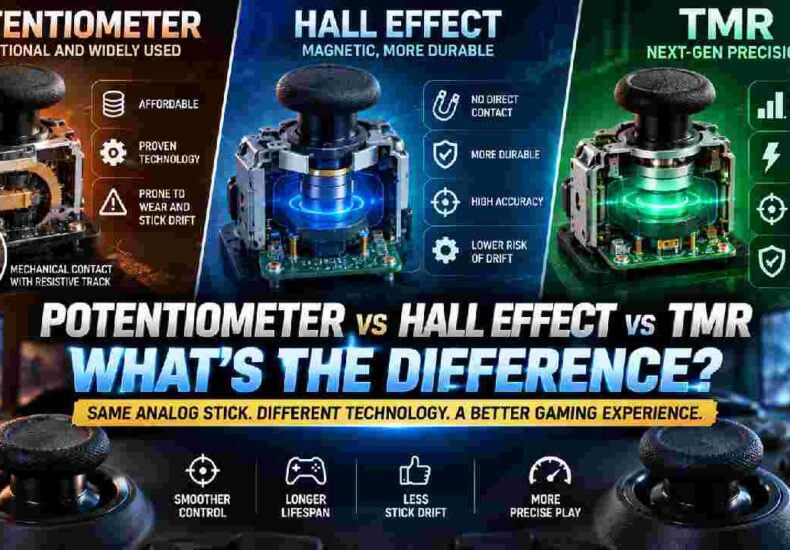
Potentiometer vs Hall Effect vs TMR: Understanding Analog Stick Technology
Fundacion Rapala – The Analog Stick Sensor Technology inside a controller has a major impact on the gaming experience. Every movement of your thumb must become an accurate command on the screen. Although an analog stick looks simple, several components work beneath its surface. These parts detect direction, distance, and changes in movement. For many years, potentiometers became the standard choice for console and PC controllers. They were affordable and easy to manufacture. However, complaints about stick drift pushed manufacturers to explore better alternatives. Hall Effect sensors later gained attention because they use magnetic fields instead of direct sensor contact. More recently, TMR has emerged as another promising option. Each technology offers different benefits in durability, precision, and efficiency. Therefore, understanding how these sensors work can help gamers choose a controller that better matches their budget, playing habits, and expectations.
Potentiometer Sticks Rely on Physical Contact
Potentiometer-based sticks have powered gaming controllers for decades. Their basic design uses resistive tracks to measure movement. When a player moves the stick, internal parts slide across these tracks. The resulting change in electrical resistance tells the controller where the stick is positioned. This technology remains popular because manufacturers understand it well. It is also relatively inexpensive to produce. Therefore, potentiometers still appear in many mainstream controllers today. However, their greatest weakness comes from physical contact. The internal surfaces rub against each other whenever the player moves the stick. Over time, friction can wear those surfaces down. Dust and other particles may also interfere with accurate readings. Eventually, the controller can register movement while the stick sits untouched in its neutral position. Gamers know this frustrating problem as stick drift. For casual users, potentiometers can still work well, but long-term wear remains an important concern.
Read More : Potentiometer vs Hall Effect vs TMR: Which Analog Stick Is Better?
Hall Effect Sensors Use Magnetic Fields
Hall Effect sticks offer a different approach to Analog Stick Sensor Technology. Instead of measuring resistance through direct contact, they detect changes in a magnetic field. A magnet moves with the stick while a sensor measures its changing position. This design removes one major source of friction from the sensing system. As a result, Hall Effect sensors can reduce the risk of drift caused by worn resistive tracks. Their growing popularity has encouraged many controller brands to adopt them, especially in enthusiast and premium models. Still, Hall Effect technology does not make a controller indestructible. Springs, plastic structures, and other mechanical parts can continue to wear over time. Sensor quality also varies between products. In addition, calibration and firmware can strongly affect accuracy. Therefore, buyers should not judge a controller only by the Hall Effect label. Good implementation remains essential for smooth, precise, and reliable performance.
TMR Offers High Sensitivity and Efficiency
TMR, or Tunnel Magnetoresistance, is another magnetic sensing technology gaining attention in modern controllers. Like Hall Effect sensors, TMR does not rely on a traditional resistive track for position detection. Instead, it measures changes in electrical resistance caused by magnetic fields within specialized materials. One major advantage is its high sensitivity. TMR sensors can detect relatively small magnetic changes, which can support detailed stick-position measurements when properly implemented. They can also operate with low power consumption. That feature is particularly useful for wireless controllers where battery efficiency matters. However, TMR alone cannot guarantee excellent gaming performance. Manufacturers must still design the stick mechanism carefully and calibrate the sensor correctly. Firmware also needs to process the readings effectively. Consequently, a well-designed Hall Effect controller can outperform a poorly implemented TMR model. The technology provides strong potential, but the complete controller design ultimately determines how that potential feels during actual gameplay.
Read More :Modified RTX 5090 Hits 900W Using Three 8-Pin Connectors
Stick Drift Has More Than One Possible Cause
Stick drift remains one of the most frustrating controller problems. It occurs when a game detects movement even though the player is not touching the analog stick. Traditional potentiometers can develop drift when their resistive tracks wear out or become contaminated. Hall Effect and TMR sensors avoid that specific wear point because their sensing methods do not require the same sliding electrical contact. However, magnetic sensing does not eliminate every possible source of unwanted input. Springs can weaken after extended use. Mechanical tolerances may also change, causing the stick to rest slightly away from its original center. Calibration problems can create similar symptoms. Meanwhile, aggressive dead-zone settings may expose tiny movements that would otherwise remain unnoticed. Therefore, consumers should be careful with claims that any controller is completely drift-proof. Hall Effect and TMR can reduce certain causes of drift, but overall durability still depends on mechanical quality, software, calibration, and long-term maintenance.
Sensor Type Alone Does Not Determine Accuracy
A common assumption is that newer Analog Stick Sensor Technology automatically delivers better aim. In practice, controller accuracy depends on much more than the sensor itself. Firmware processing plays a significant role in translating raw sensor data into movement. Dead zones also determine how quickly the controller reacts near the center position. In addition, stick geometry and mechanical tension can change how precise a controller feels. Polling behavior and game settings add further variables. For example, a sensitive sensor may provide detailed readings, but a large software dead zone can hide that advantage. Likewise, extremely small dead zones may reveal minor mechanical imperfections. This explains why two controllers using the same sensor technology can feel completely different. Competitive players should therefore consider independent testing and calibration options alongside technical specifications. A balanced combination of hardware and software usually matters more than simply choosing the newest sensor available.
Which Analog Stick Technology Should You Choose?
Choosing between potentiometer, Hall Effect, and TMR depends on how you play and how much you want to spend. Potentiometers remain attractive for affordable controllers because they are mature and widely available. However, their contact-based design makes sensor wear a greater concern. Hall Effect sticks provide a strong middle ground. Magnetic sensing reduces resistive-track wear, while the technology is now available across many price categories. TMR offers another step forward in sensitivity and power efficiency. For that reason, it can be attractive in premium and wireless controllers. Still, buyers should avoid choosing a controller based on sensor type alone. Build quality, firmware, calibration, ergonomics, warranty support, and repairability also deserve attention. For many gamers, Hall Effect currently offers an appealing balance between price and durability. Meanwhile, TMR becomes particularly interesting for users who value newer magnetic sensing technology and highly refined controller designs.