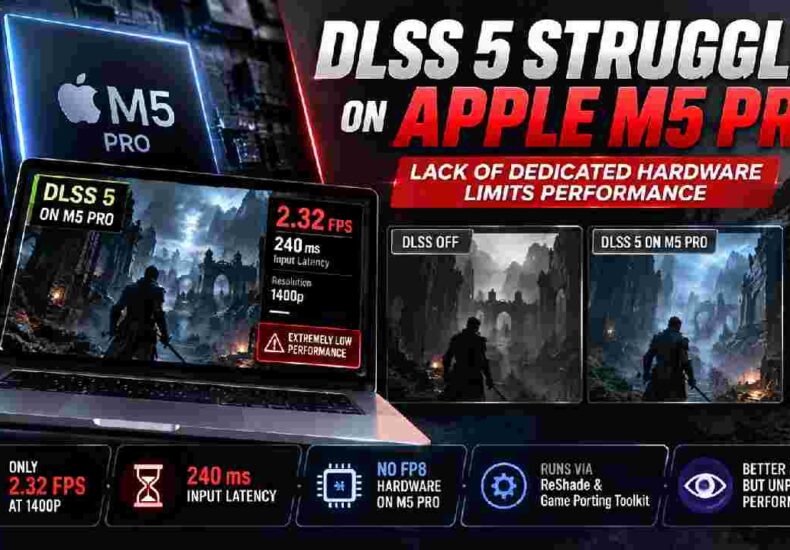
DLSS 5 Struggles on Apple M5 Pro as Hardware Limits Become Clear
Fundacion Rapala – DLSS 5 Apple M5 Pro testing has drawn attention after enthusiasts tried NVIDIA’s emerging neural rendering technology on Apple Silicon. Interest grew after files linked to DLSS 5 reportedly appeared through NBA 2K27, which encouraged users to test the feature on other hardware. One Mac gaming community member managed to run it on an M5 Pro with ReShade and Apple’s Game Porting Toolkit 4.0 beta 2. The experiment proved that the feature could launch, but the results quickly exposed major limits. Lighting looked more refined in some scenes, yet frame rates collapsed and latency rose sharply. This outcome does not mean the M5 Pro is a weak chip. Instead, it shows what can happen when software expects hardware features that the platform does not provide. For gamers, the test offers an early look at how strongly future graphics may depend on specialized AI acceleration.
Frame Rates Drop to an Almost Unplayable Level
The biggest concern came from the raw performance numbers. According to the community test, the M5 Pro’s 16-core GPU reached only about 2.32 frames per second at roughly 1400p after DLSS 5 was enabled. Input latency also rose to around 240 milliseconds. At that level, most games would feel almost impossible to control, especially fast action titles that depend on quick reactions. However, readers should treat these figures as an experimental result, not as an official benchmark for Apple Silicon or the final form of DLSS 5. The setup used unofficial software, compatibility tools, and technology outside its normal target environment. Even so, the test remains useful because it highlights an important point. Running an advanced graphics feature is not the same as running it efficiently. Hardware design, software support, and optimized AI pathways can decide whether a feature feels impressive or unusable.
Read More : KDE Plasma vs GNOME vs Cinnamon vs Xfce: Which Linux Desktop Fits You?
Missing FP8 Support May Be the Main Problem
One likely reason for the poor result involves the M5 Pro’s support for lower-precision AI math. The tester argued that this DLSS 5 workload benefits from FP8, or 8-bit floating-point processing, while the M5 Pro relies on FP16 for the relevant task. FP8 can speed up some machine-learning operations because it reduces the amount of data the hardware must process. If software expects that path, using a heavier format can create a major performance penalty. This makes the DLSS 5 Apple M5 Pro test more of an architecture mismatch than a simple contest of GPU power. Modern chips now include dedicated blocks for specific AI jobs, and software increasingly depends on those blocks. When a platform lacks the expected capability, general-purpose resources must work harder. The experiment therefore shows why raw specifications alone cannot predict performance in modern neural rendering.
Better Lighting Cannot Save Poor Gameplay Performance
The experiment still produced one encouraging result: lighting quality improved in some scenes. That detail helps explain why neural rendering has become such an important topic in modern graphics. Machine-learning systems can enhance lighting, reconstruct detail, and reduce the workload of traditional rendering techniques. Yet image quality means little when responsiveness disappears. At roughly 2.32 frames per second, motion becomes extremely choppy, while about 240 milliseconds of input delay makes controls feel disconnected. For gamers, smooth response matters as much as visual detail. This creates a difficult balance for developers. They must improve image quality without pushing the hardware beyond what it can process in real time. The M5 Pro test captures that challenge clearly. DLSS 5 may improve certain visual elements, but without the right acceleration path, the cost can become too high for practical gameplay.
Read More :NVIDIA Acquires Hugging Face, Raising Big Questions for Open-Source AI
The Test Does Not Define Overall Mac Gaming Performance
It is important not to read this experiment as proof that the M5 Pro performs badly in games overall. DLSS belongs to NVIDIA’s graphics ecosystem, and developers usually build it around NVIDIA hardware and software support. In this test, the feature ran through ReShade and Apple’s Game Porting Toolkit, which added extra layers between the game and the hardware. Those layers can increase overhead and affect performance. The files involved also came from an unreleased or unofficial implementation, so the final technology could behave differently. For that reason, the result works better as a technical demonstration than as a direct Apple-versus-NVIDIA comparison. It shows that a powerful GPU can still struggle when software asks it to handle a workload outside its preferred design. For developers, that lesson matters because modern graphics now rely more heavily on specialized acceleration and platform-specific optimization.
Apple M6 Could Improve Future AI Graphics Workloads
The discussion has also shifted toward Apple’s next generation of silicon. Reports linked to the experiment suggest that future M6 chips may add FP8 support, which could improve performance in some AI and neural rendering workloads. However, FP8 support alone would not guarantee native DLSS 5 compatibility on a Mac. NVIDIA controls DLSS, while Apple develops its own graphics architecture, software stack, and machine-learning tools. A future Apple chip could process similar workloads more efficiently without directly supporting NVIDIA’s technology. Even so, the broader trend is clear. Gaming graphics are moving toward a mix of traditional rendering and AI-assisted processing. As that shift continues, dedicated AI hardware will matter more. The DLSS 5 Apple M5 Pro experiment offers an early example of this transition. It shows how much performance can depend on the exact hardware path that a graphics feature expects.
AI Hardware Is Changing the Meaning of Gaming Performance
For gamers, this experiment shows how quickly the meaning of a powerful graphics chip is changing. Raw shader performance still matters, but neural rendering adds another layer to the competition. Future GPUs may rely more on dedicated hardware for reconstruction, frame generation, lighting, and other AI-driven tasks. That trend could shape the strategies of Apple, NVIDIA, AMD, Intel, and game developers over the next few years. At the same time, users should avoid judging any platform from one experimental test. The M5 Pro result does not show how an officially optimized neural rendering system would perform on Apple hardware. Instead, it shows the cost of running demanding software without the ideal acceleration path. As gaming becomes more dependent on AI, compatibility and optimization may matter almost as much as raw computing power. The next generation of chips will need both.