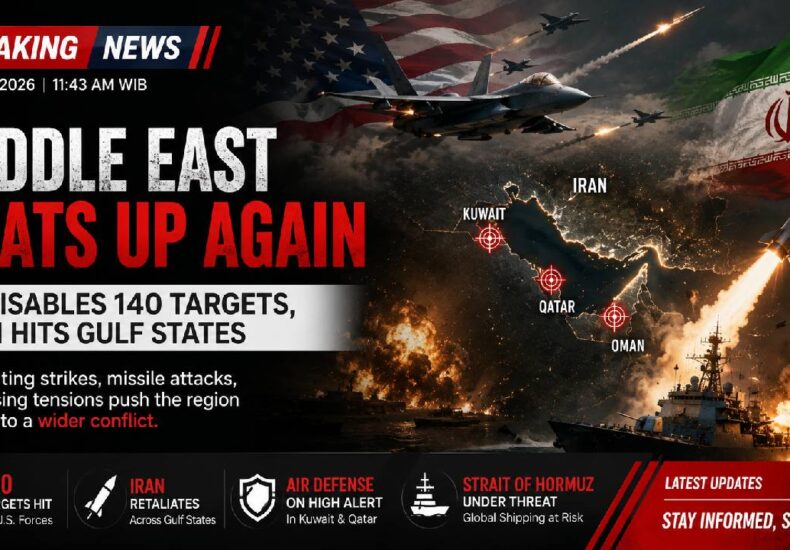
US Strikes 140 Iranian Targets as Gulf States Face Retaliation
Fundacion Rapala – The Middle East entered another dangerous chapter on July 12, 2026, after the United States launched a fresh round of strikes against Iran. US Central Command, widely known as CENTCOM, said its forces targeted approximately 140 Iranian military sites during the latest operation. The strikes reportedly hit missile positions, drone facilities, ammunition warehouses, naval capabilities, communication networks, and coastal surveillance systems. According to the US military, the operation aimed to weaken Iran’s ability to threaten civilian sailors and commercial vessels crossing the Strait of Hormuz. However, the explosions carried consequences far beyond military compounds. Families across the region followed emergency alerts, watched the skies, and prepared for possible retaliation. For many residents, the latest exchange revived the exhausting fear that another regional conflict could spread quickly across borders.
Washington Links the Operation to Attacks on Commercial Shipping
US officials described the strikes as a response to Iran’s recent attacks on commercial vessels, including a Cyprus-flagged ship near the Strait of Hormuz. CENTCOM said American forces had hit more than 300 targets over three nights as part of a wider effort to protect maritime traffic. Since early May, the military also claimed that it had supported more than 800 commercial ships carrying vital goods, including hundreds of millions of barrels of oil, through the strategic passage. The Strait of Hormuz remains one of the world’s most important energy routes, so even a brief disruption can affect shipping schedules, fuel supplies, and global prices. Yet behind those statistics are crews who spend long hours navigating waters filled with uncertainty. Each warning signal, military aircraft, or distant explosion reminds sailors that an ordinary journey can suddenly become a life-threatening mission.
Read More : Mount Erebus Releases Tiny Gold
Iran Expands Its Retaliation Toward Gulf Countries
Iran responded by launching missiles and drones toward several Gulf countries that host or support American military operations. Iranian forces claimed they struck logistical facilities and refuelling platforms linked to US naval activity at Oman’s Port of Duqm. Reports also indicated attacks or attempted attacks involving Kuwait, Qatar, Bahrain, Jordan, and the United Arab Emirates. Iran’s Islamic Revolutionary Guard Corps presented the operation as another phase of its response to American bombing. However, the expansion of strikes into neighbouring countries created a new level of anxiety. These nations have often tried to maintain security and economic stability while balancing complex relationships with both Washington and Tehran. As air-defence systems activated above cities, the conflict no longer felt distant. It reached communities whose residents had hoped that diplomacy could keep their streets, airports, ports, and workplaces outside the battlefield.
Kuwait and Qatar Raise Their Security Readiness
Kuwaiti authorities announced that the country’s armed forces were responding to hostile aerial threats entering its airspace. The military explained that residents might hear explosions as air-defence systems intercepted incoming missiles or drones. Officials urged the public to follow authorised safety instructions and avoid spreading unverified information. Meanwhile, Qatar raised its national security threat level to high for the second time that morning. The Interior Ministry advised people to remain indoors or move to secure locations while emergency agencies assessed the danger. Such warnings changed the rhythm of daily life almost instantly. Parents called family members, businesses adjusted operations, and residents checked official updates with growing concern. Although defence systems can stop physical threats, they cannot immediately remove the emotional pressure caused by sirens and uncertainty. For ordinary people, waiting safely indoors became another painful reminder of how quickly geopolitical rivalry can reach their homes.
Read More : Venezuela Urges UK to Release 31 Tons o
The Strait of Hormuz Returns to the Centre of the Crisis
The renewed confrontation has placed the Strait of Hormuz at the heart of military and economic calculations. This narrow waterway connects Gulf energy producers with major international markets, making it essential for oil and gas transportation. Recent fighting has already reduced shipping activity, while vessel operators face difficult decisions about routes, insurance, crew safety, and delivery schedules. Iran has repeatedly challenged efforts to control or redirect maritime traffic, while the United States has insisted that commercial ships must travel freely. Consequently, every attack on a vessel risks triggering a much wider response. Governments view the strait as a strategic asset, but sailors experience it as a workplace filled with practical dangers. The people aboard tankers and cargo ships do not control diplomatic decisions, yet they often carry the heaviest immediate risks when military tensions rise.
Regional Governments Face Increasing Pressure to Choose Sides
Gulf governments now face a difficult diplomatic challenge as the confrontation intensifies. Many host American forces or maintain security partnerships with Washington, yet they also live beside Iran and depend on stable regional trade. Supporting one side too openly could invite retaliation, while remaining neutral may become harder as missiles cross national airspace. Oman and Qatar have previously played important mediation roles, but continued attacks could weaken the space available for negotiations. At the same time, leaders must reassure citizens, protect critical infrastructure, and prevent economic panic. Their decisions carry human consequences because prolonged instability could disrupt employment, travel, education, healthcare, and energy supplies. Although political statements often focus on deterrence and strategic interests, residents mainly want safety. They want to send children to school, travel to work, and sleep without hearing alarms or wondering where the next strike may land.
Diplomacy Struggles to Survive as Military Exchanges Continue
Despite the expanding military confrontation, diplomatic efforts have not completely disappeared. Reports before the latest attacks suggested that mediators were still trying to revive communication between Washington and Tehran. However, each new strike makes trust more difficult to rebuild. Leaders may believe military pressure strengthens their negotiating position, but repeated retaliation can also create miscalculations that neither side originally intended. A missile intercepted over one country or a damaged commercial vessel could quickly trigger another round of attacks. Therefore, the greatest danger may not come from a carefully planned regional war, but from decisions made under pressure and anger. Across Iran and the Gulf, civilians continue to carry the emotional burden of that uncertainty. Their daily lives reveal the true cost of escalation: fear spreads faster than official statements, while peace becomes harder to imagine with every explosion.