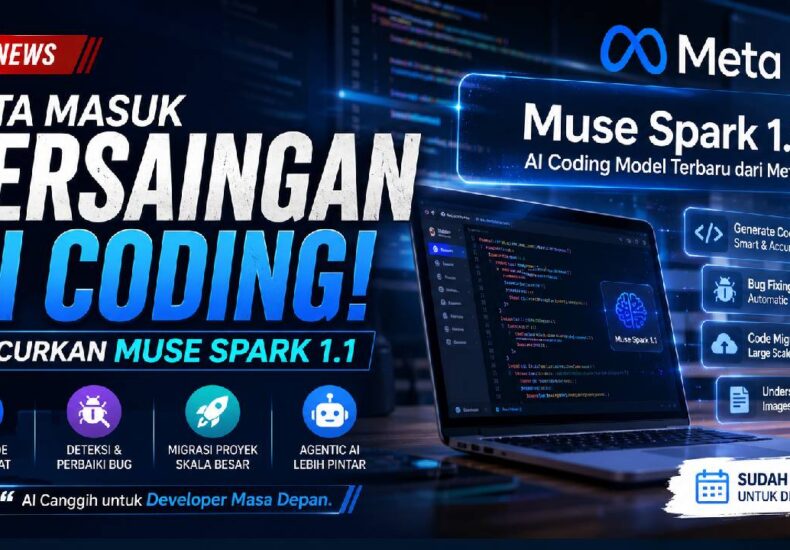
Meta Expands AI Coding Race with the Launch of Muse Spark 1.1
Fundacion Rapala – Meta has officially entered the fast-growing AI coding market with the introduction of Muse Spark 1.1. The new model aims to help software developers build applications faster and solve programming challenges more efficiently. While Meta has invested heavily in artificial intelligence over the past few years, this release marks one of its strongest moves into developer-focused AI. Unlike earlier experimental tools, Muse Spark 1.1 is designed for real-world coding tasks. It assists with writing code, fixing bugs, and handling large software migrations. As AI becomes a standard tool for programming, Meta wants to become a serious competitor alongside OpenAI, Anthropic, and Google. Consequently, developers now have another powerful option when choosing an AI assistant for professional software development.
Built for More Than Simple Code Generation
Muse Spark 1.1 goes beyond basic code completion. According to Meta, the model supports agentic AI, allowing it to complete tasks that require planning and coordination across multiple tools and services. Therefore, developers can automate workflows instead of handling every step manually. The model can analyze software documentation, understand images and videos, and combine different sources of information before generating solutions. In addition, it helps identify software bugs and suggests practical fixes with greater accuracy. These capabilities make the platform useful for both individual developers and enterprise teams. Rather than acting like a simple chatbot, Muse Spark 1.1 behaves more like a digital programming partner that supports complex software engineering projects.
Read More : Google’s Android Becomes More Closed, Raising Concerns Among Custom ROM Developers
Preview Access Gives Developers an Early Opportunity
Meta has opened preview access to Muse Spark 1.1 through a dedicated API for developers. This approach allows companies and independent programmers to integrate the model into their existing applications and development environments. Instead of waiting for a full public release, developers can begin testing its capabilities immediately. Early access also enables Meta to collect valuable feedback before wider deployment. Furthermore, the API supports different software workflows, making integration more flexible for various industries. Developers receive an initial credit worth 20 US dollars, allowing them to explore the platform without immediate costs. As a result, more teams can evaluate whether Muse Spark 1.1 fits their software development needs before committing to commercial use.
Meta Introduces a Commercial Pricing Strategy
Unlike many of Meta’s previous AI models, Muse Spark 1.1 follows a commercial pricing model. After developers use the free trial credits, they pay approximately 1.25 US dollars per one million input tokens and 4.25 US dollars per one million output tokens. Meta says this aggressive pricing strategy is intended to remain competitive with similar services from OpenAI and Anthropic. This decision also reflects the growing demand for premium AI tools in professional software development. While open-source AI remains important to Meta, the company now recognizes that enterprise-grade services require sustainable business models. Consequently, Muse Spark 1.1 represents a significant shift in Meta’s broader AI strategy and long-term commercial ambitions.
Read More :AI Adoption Accelerates Cloud Security Risks as Businesses Face Growing Digital Challenges
Integration Across the Meta AI Ecosystem
Meta plans to integrate Muse Spark 1.1 into its existing AI ecosystem instead of limiting it to developers. Over time, the model is expected to power Meta AI across WhatsApp, Facebook, Instagram, Meta’s website, and future smart devices. This broad integration could improve chatbot responses while enabling more advanced automation across Meta’s digital platforms. Moreover, Muse Spark 1.1 may eventually replace earlier AI models currently supporting Meta’s conversational services. By using one advanced foundation model across multiple products, Meta hopes to create a more consistent AI experience for users worldwide. This strategy also strengthens the company’s position as AI becomes central to everyday digital communication.
Competition in AI Coding Continues to Intensify
The AI coding industry is becoming increasingly competitive as major technology companies accelerate innovation. OpenAI continues expanding its programming capabilities through GPT-5.6 and ChatGPT Work. Anthropic strengthens its position with Claude Code, while Google enhances Gemini for software development. Now, Meta joins this rapidly evolving market with Muse Spark 1.1. Each company is racing to build AI systems that generate cleaner code, solve programming problems faster, and automate repetitive engineering tasks. Consequently, developers benefit from greater competition and continuous improvements across the industry. As AI coding tools become more capable, software creation is likely to become faster, more accessible, and increasingly collaborative for professionals and businesses around the world.