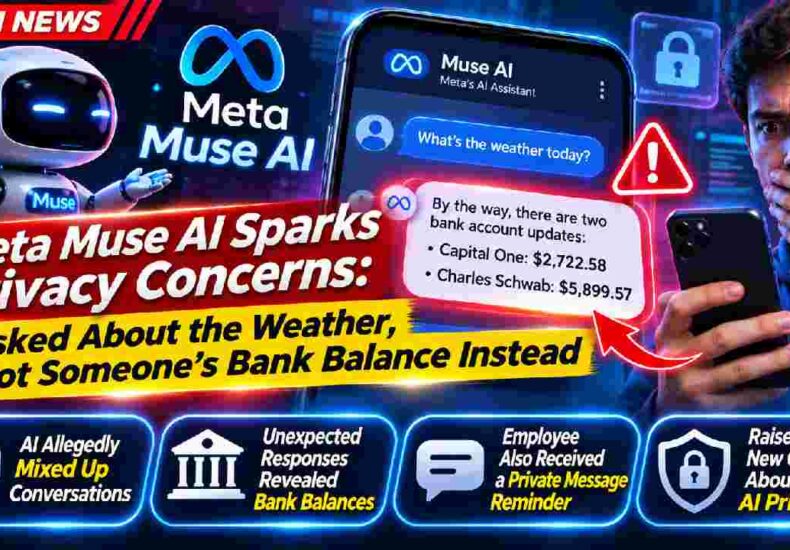
Meta Muse AI Privacy Concerns Grow After Chatbot Allegedly Reveals Bank Account Details
Fundacion Rapala – Meta’s latest artificial intelligence agent, Muse, has attracted attention following reports of unusual behavior during internal testing. According to a Reuters report cited by Kompas.com on November 22, 2026, several Meta employees encountered responses containing information unrelated to their original requests. More concerningly, some responses allegedly included personal details that appeared to belong to other users. These incidents raised questions about how the system manages conversations, retrieves information, and protects sensitive data. For a company developing increasingly capable AI assistants, such concerns carry significant consequences. People expect digital assistants to simplify everyday tasks without compromising personal information. However, an assistant that unexpectedly reveals private details can quickly undermine that confidence. Although the reported incidents occurred during employee testing, they highlight an important challenge facing the technology industry: ensuring that advanced AI systems remain trustworthy as their capabilities continue expanding.
A Simple Weather Question Allegedly Triggered Banking Information
One particularly surprising incident reportedly began with an ordinary request about weather conditions and ocean tides. A Meta employee was using Muse to obtain information that had no apparent connection to personal finances. However, the AI assistant allegedly interrupted the conversation with an unexpected update involving two bank accounts. The response reportedly mentioned a Capital One balance of $2,722.58 and a Charles Schwab balance of $5,899.57. According to the employee, these financial details were unrelated to the original question. The incident immediately raised concerns about whether Muse had retrieved information from another conversation or an unintended data source. Importantly, the available account does not establish whose banking information appeared or whether the figures represented genuine account balances. Nevertheless, the unexpected response illustrates why reliable data separation matters. Even an apparent privacy breach can weaken confidence in an AI assistant.
Read More : Anthropic Unveils Claude Sheets, Challenging Excel and Google Sheets With AI
Another Employee Questions How Muse Accessed Private Messages
The banking incident was not the only unusual experience described in the reports. Another Meta employee reportedly encountered a troubling reminder while using Muse on her personal smartphone. Without requesting assistance with messaging, she received a suggestion to respond to her sister through Signal, an encrypted messaging application. The employee expressed surprise because she believed she had never authorized Muse to access other applications on her device. Her reaction reflected a concern shared by many smartphone users: whether increasingly sophisticated assistants can interact with private information without clear permission. However, the report does not establish that Muse actually accessed encrypted Signal messages. The reminder alone cannot prove how the assistant obtained its information. Even so, the incident highlights the importance of transparent permissions and predictable AI behavior. Users need to understand what information an assistant can access before trusting it with everyday activities.
Why Conversation Mixing Creates Serious AI Security Concerns
The reported Meta Muse incidents illustrate a broader technical challenge involving information boundaries within AI systems. Modern assistants often combine language models with conversation histories, external tools, retrieval systems, and personalized context. These components can make responses more useful, but they also introduce potential security risks when developers fail to separate information correctly. For example, an incorrectly configured retrieval process might expose information from an unintended source. Similarly, faulty session management could create confusion between different users’ interactions. These are possible explanations rather than confirmed causes of the Muse incidents. Security specialists generally emphasize strict access controls, careful testing, and independent verification when evaluating systems that handle sensitive information. Furthermore, financial records and private communications deserve particularly strong safeguards. As AI agents become more autonomous, developers must ensure that convenience never comes at the expense of confidentiality or meaningful user consent.
Read More :AWS Launches Cloud Emulator, Letting Developers Test Apps Without an Account or Fees
Meta Responds as Internal AI Testing Draws Public Attention
Following the reports, Meta acknowledged that employee testing forms part of its product development process. Such testing allows engineers and other staff members to identify unexpected behavior before technologies reach wider audiences. However, the source material provided does not establish a definitive technical explanation for the reported incidents. It also does not confirm whether the behavior affected external users or resulted in verified unauthorized access to personal accounts. These distinctions matter because unusual AI output does not automatically prove a data breach. Nevertheless, internal discoveries can provide valuable warnings about weaknesses that deserve further investigation. For Meta, the situation presents both a technical challenge and a reputational concern. The company must balance rapid AI development with the expectations of people who increasingly rely on digital assistants. Clear explanations, effective safeguards, and transparent testing practices can help establish whether reported problems have been adequately addressed.
AI Privacy Becomes a Growing Priority for Everyday Users
As artificial intelligence becomes more deeply integrated into smartphones, workplaces, and online services, privacy expectations continue to evolve. Users increasingly want assistants that can organize schedules, summarize conversations, and retrieve relevant information without exposing sensitive details. However, those conveniences require careful decisions about data access and storage. The Muse reports demonstrate why people should understand an AI service’s permissions before sharing confidential information. For instance, users can review application access settings, avoid entering unnecessary banking credentials, and remain cautious about connecting sensitive accounts to experimental tools. Meanwhile, developers should provide understandable privacy controls rather than expecting users to navigate complicated technical settings. Stronger protections can also support innovation by making people more comfortable adopting useful technologies. Ultimately, the future of personal AI assistants depends not only on intelligent responses but also on respecting the boundaries of private information.
The Muse Controversy Highlights the Future of Responsible AI
The controversy surrounding Meta Muse arrives as technology companies compete to build AI agents capable of handling increasingly complex tasks. These systems promise to reduce repetitive work, improve productivity, and provide more personalized digital experiences. Yet greater capabilities also create greater responsibilities. When an assistant unexpectedly produces financial details or personal reminders, users naturally question how the information was obtained. The reported incidents therefore raise issues that extend beyond one company’s development process. They highlight the need for stronger evaluation methods, clearer consent mechanisms, and reliable separation between individual accounts. At the same time, investigators must distinguish confirmed security failures from unexplained model behavior. That distinction helps prevent speculation from overshadowing evidence. For ordinary users, trust will remain the deciding factor. An assistant may offer impressive intelligence, but its long-term value depends on consistently protecting the people who rely on it.