President Donald Trump Pushes Single National AI Rulebook, Stirring Hope and Anxiety Across the US
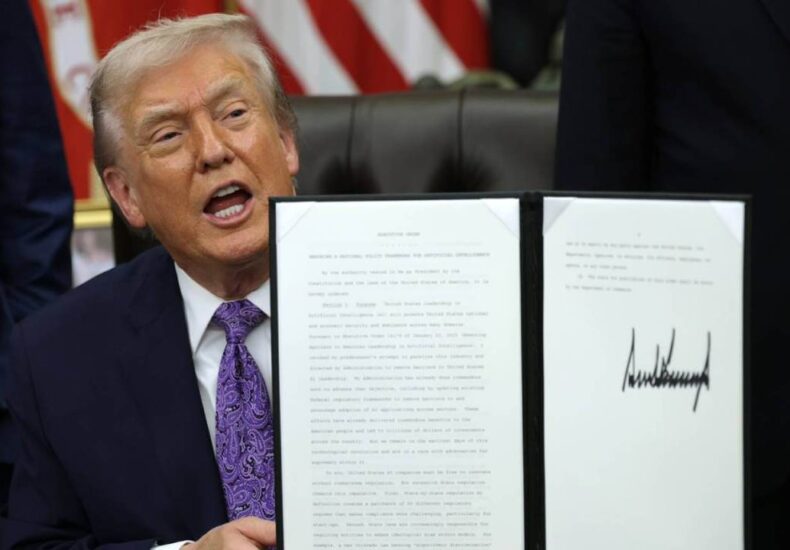
Fundacion Rapala – President Donald Trump stepped into the Oval Office spotlight with a decisive move that could redefine America’s artificial intelligence landscape. By signing an executive order blocking states from enforcing their own AI regulations, Trump sent a clear message: the future of AI should follow one national path. According to the administration, fragmented state laws risk slowing innovation and weakening US leadership in the global AI race. Therefore, the order directs federal agencies to prioritize a unified framework rather than a patchwork of rules. For tech companies, this signals clarity and speed. For others, however, it raises concerns about oversight and safety. The moment felt historic, not because AI is new, but because its influence now touches daily life. From jobs to healthcare, the decision carries emotional weight for workers, families, and communities navigating a rapidly changing digital era.
Why the White House Wants One AI Framework
Behind the executive order lies a strategic calculation. White House officials argue that allowing each state to regulate AI independently could cripple innovation before it fully matures. Will Scharf, a senior aide, emphasized that conflicting rules create uncertainty for developers and investors. As a result, companies may hesitate to build or deploy AI tools at scale. The administration believes a single federal framework offers stability while preserving America’s competitive edge, particularly against China. Moreover, AI already fuels major sectors of the economy and stock market. Without consistency, progress could slow. However, the order does not eliminate all state authority. Notably, child safety protections remain untouched. This carve-out reflects an attempt to balance innovation with responsibility. Still, the debate over who should control AI’s guardrails has only intensified.
“Read More : Warren Buffett, the Quiet Zen Master of Modern Capitalism”
Silicon Valley Welcomes Clarity, With Cautious Optimism
In tech circles, reactions have been largely supportive, though measured. Industry leaders have long warned that navigating dozens of state laws could drain resources and delay breakthroughs. OpenAI CEO Sam Altman and others argue that innovation thrives on clear rules. Consequently, many see the order as a lifeline that preserves momentum. Venture capital firms echoed this sentiment, calling the move an essential first step. Yet optimism comes with conditions. Even supporters admit the executive order cannot replace comprehensive legislation. Without Congress, uncertainty remains. Companies want assurance not only about freedom to innovate, but also about long-term expectations. For now, Silicon Valley breathes easier. Still, many executives quietly acknowledge that trust, not speed alone, will determine AI’s future acceptance.
Critics Fear a Dangerous Accountability Gap
While tech leaders applaud, critics see warning signs. Consumer advocates worry that limiting state power weakens protections just as AI expands into sensitive areas. From hiring algorithms to deepfake content, harms are already emerging. Without state-level safeguards, critics argue companies may evade responsibility. Brad Carson of Americans for Responsible Innovation warned the order could face serious legal challenges. He emphasized that many state laws reflect strong public support. Furthermore, opponents stress that the executive order offers no immediate federal replacement. This regulatory gap fuels anxiety among workers, parents, and marginalized communities. They fear unchecked systems could reinforce bias or misinformation. As AI grows more powerful, accountability becomes personal. For many Americans, this debate is not abstract. It affects livelihoods, privacy, and trust.
“Read More :How People Can Shape Global Politics Through Game Theory and Civic Power”
Congress Still Holds the Long-Term Answer
Despite the bold executive action, Congress remains central to AI’s future. Lawmakers previously rejected efforts to block state regulations, signaling deep divisions. Republicans and conservatives themselves remain split. Some, like Vice President JD Vance, favor lighter oversight. Others, including Florida Governor Ron DeSantis, argue states need authority to act quickly. This divide highlights a broader struggle over governance in the digital age. Executive orders can guide direction, but lasting clarity requires legislation. Even supporters of Trump’s move admit this reality. Until Congress acts, the nation exists in regulatory limbo. The stakes are high. Decisions made now will shape innovation, security, and public trust for decades.
Balancing Innovation With Human Impact
At its core, the AI regulation debate is about people, not machines. Supporters envision progress, jobs, and global leadership. Critics see risks to fairness, safety, and accountability. Trump’s executive order reflects confidence in American innovation, but also exposes unresolved fears. Technology moves faster than policy, leaving communities to adapt in real time. As AI reshapes work, education, and relationships, regulation becomes deeply emotional. Families worry about privacy. Workers fear displacement. Developers seek freedom to build. The challenge ahead is not choosing sides, but finding balance. Whether this order marks progress or provokes backlash will depend on what comes next. One thing is certain: the conversation around AI and power has only just begun.