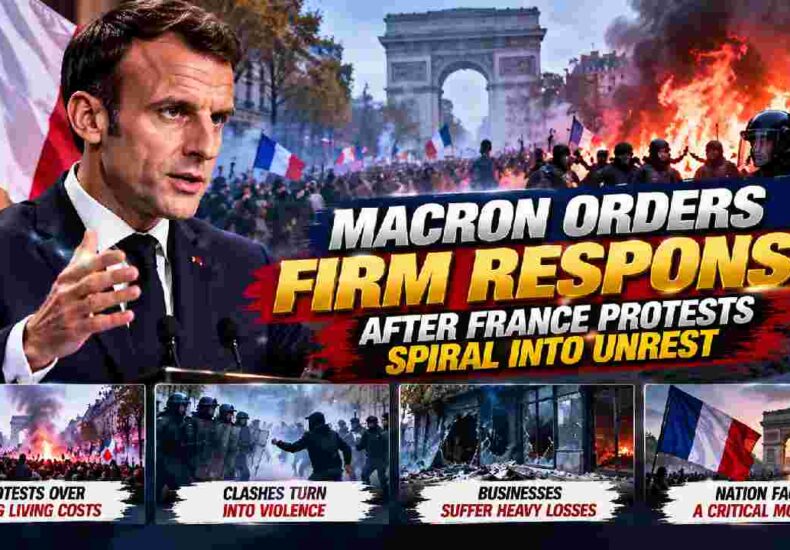
Macron Orders Firm Response After France Protests Spiral Into Unrest
Fundacion Rapala – France entered a tense new chapter after demonstrations over the rising cost of living descended into disorder across several areas. What began as public frustration over household expenses developed into scenes of damaged shops, clashes, and widespread concern. President Emmanuel Macron responded by addressing the nation and promising measures to protect cities, public buildings, and businesses. His message attempted to draw a clear line between peaceful protest and destructive behavior. For many French families, however, the unrest reflects a deeper anxiety about daily expenses and economic pressure. That makes the France cost of living protests more than a security issue. They also reveal growing frustration among citizens who feel increasingly squeezed. As authorities work to restore calm, the government faces the difficult task of maintaining public order without ignoring the economic concerns that brought people into the streets.
Macron Rejects Violence While Recognizing Peaceful Protest
In his response to the unrest, Macron emphasized that violence, destruction, and looting could not be justified by political or economic frustration. At the same time, he distinguished people expressing legitimate concerns from individuals responsible for damaging property. That distinction matters because France has a long tradition of public demonstrations as a form of democratic expression. Therefore, treating every participant as a threat could deepen tensions rather than reduce them. Macron instead presented a tougher approach toward those involved in destructive acts while leaving room for peaceful dissent. His comments also carried an emotional tone as he described the damage to French streets and businesses as unacceptable. The France cost of living protests have consequently become a test of political balance. The government must restore security quickly, yet it also needs to show citizens that peaceful criticism still has a meaningful place in national debate.
Read More : West Bank Violence Draws Global Scrutiny After French Mayor Attacked
Businesses and Communities Count the Cost of Unrest
Behind the dramatic images of damaged storefronts lies a quieter story involving workers, shop owners, and families whose livelihoods depend on local commerce. When demonstrations turn violent, small businesses often absorb the consequences immediately. A broken window, forced closure, or disrupted delivery can become a serious financial burden, particularly when operating costs are already rising. Macron promised support for businesses affected by the disorder, signaling that economic recovery will form part of the government response. Yet financial assistance alone may not erase the anxiety created by unpredictable street violence. Employees also face uncertainty when transport networks, commercial districts, or workplaces become difficult to access. In this sense, the France cost of living protests have produced an uncomfortable paradox. Demonstrators are protesting economic hardship, while the resulting unrest can create additional financial pressure for communities already struggling with higher expenses and uncertain household budgets.
Police Response Comes Under Growing Public Scrutiny
Questions surrounding police preparation have added another layer to the political challenge. Critics have questioned whether security forces were sufficiently prepared for demonstrations that eventually became difficult to control. Macron responded by promising transparency over the authorities’ handling of the unrest. That commitment could prove important because public confidence depends not only on restoring order but also on demonstrating accountability. Police officers face a complicated situation during large demonstrations. They must protect people and property while avoiding unnecessary escalation against peaceful participants. Meanwhile, rapidly changing crowds can make operational decisions difficult within minutes. As a result, any review of the response should examine planning, communication, deployment, and decisions made on the ground. The government now faces pressure from several directions. Citizens want safer streets, peaceful demonstrators expect their rights to remain protected, and businesses want reassurance that authorities can prevent another wave of widespread destruction.
Read More : Argentina’s University Funding Crisis Spills Into Buenos Aires Streets
Rising Living Costs Remain at the Heart of Anger
Although the violence has dominated headlines, the original source of public frustration remains important: pressure from the rising cost of living. Household budgets can become increasingly fragile when essential expenses climb faster than income. Food, housing, transportation, and energy costs shape daily life far more directly than abstract economic indicators. Consequently, public anger can intensify when families believe policymakers are moving too slowly. The France cost of living protests illustrate how economic pressure can evolve into a broader political challenge when frustration accumulates. However, violent disorder risks pushing those original concerns away from the center of discussion. Images of looting and destruction can quickly overshadow conversations about purchasing power and household insecurity. For Macron’s government, restoring calm may therefore be only the first step. The harder challenge will involve addressing the underlying grievances convincingly enough to prevent anger from returning to the streets.
Macron Faces a Difficult Test of Leadership
The unrest places Macron in a politically delicate position because every response carries potential consequences. A security-first strategy may reassure businesses and residents frightened by disorder, but an excessively aggressive approach could alienate peaceful protesters. Conversely, a response viewed as too cautious could create doubts about the government’s ability to protect communities. Macron has therefore emphasized coordination with local leaders while promising firm action against those responsible for destruction. This approach suggests an effort to combine local knowledge with national authority. Yet leadership during social unrest requires more than tactical decisions. Political communication also matters, especially when public emotions are intense. People need to understand what authorities are doing, why particular measures are necessary, and how legitimate economic concerns will receive attention. The coming response could shape public perceptions of Macron’s ability to manage both security pressures and the social grievances fueling the demonstrations.
France Searches for Calm Beyond the Damaged Streets
Once damaged streets are cleared and businesses reopen, France will still face the deeper questions exposed by the unrest. Restoring order can happen relatively quickly, but rebuilding confidence between citizens, institutions, and authorities usually takes longer. The government will need to demonstrate that accountability applies to those responsible for violence while ensuring peaceful protesters retain space to express dissatisfaction. At the same time, economic concerns cannot disappear from the conversation simply because the demonstrations became chaotic. The France cost of living protests have highlighted how financial pressure can influence social stability when people feel increasingly uncertain about their future. For residents watching events unfold, the next phase may matter as much as the weekend itself. France now needs both public safety and meaningful dialogue. Whether those two goals can move forward together will help determine whether the streets remain calm or frustration resurfaces.