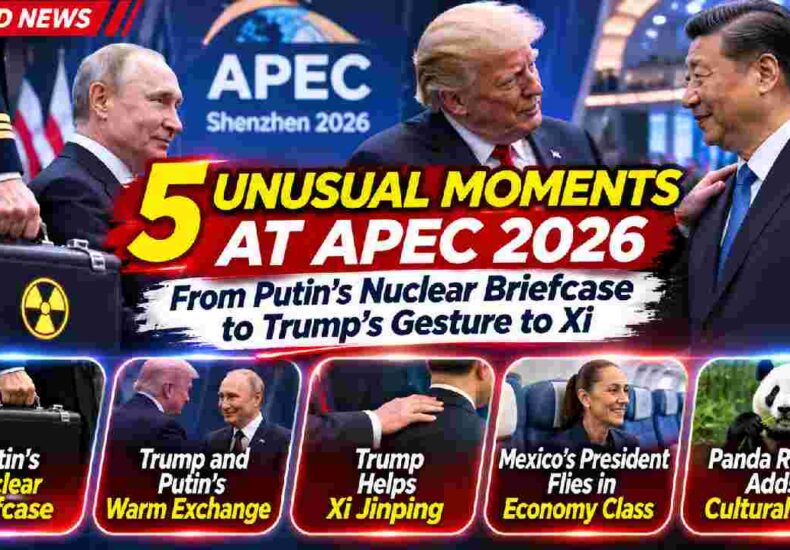
Putin’s Nuclear Briefcase and Trump’s Gesture: Five Unusual Moments at APEC 2026
Fundacion Rapala – The APEC 2026 summit in Shenzhen, China, became more than a gathering of influential world leaders. On November 19, representatives from major Asia-Pacific economies met to discuss cooperation, economic stability, and regional challenges. However, several unexpected moments attracted almost as much attention as the diplomatic discussions themselves. From an unusual presidential travel arrangement to a mysterious Russian nuclear briefcase, the summit offered fascinating glimpses into international politics. Meanwhile, interactions involving Donald Trump, Vladimir Putin, and Xi Jinping sparked conversations beyond traditional diplomatic circles. These moments reminded observers that global leadership involves more than formal speeches and carefully negotiated agreements. Small gestures, personal decisions, and security arrangements can shape public perceptions of powerful political figures. As photographs and videos circulated online, the Shenzhen summit demonstrated how human behavior can sometimes become an unexpected part of international diplomacy.
1. Mexico’s President Claudia Sheinbaum Chooses Economy Class Travel
One of the most surprising stories surrounding APEC 2026 involved Mexican President Claudia Sheinbaum. While many international leaders arrived aboard government aircraft, Sheinbaum reportedly traveled to China using a commercial flight in economy class. Her decision quickly attracted attention on Chinese social media, where observers praised the unusual approach. Instead of emphasizing presidential privileges, she appeared to demonstrate the spending discipline associated with Mexico’s government austerity policies. Moreover, footage shared through her social media account showed a relatively modest airport arrival, followed by greetings from Chinese officials and schoolchildren. The journey reflected a political tradition that prioritizes reducing unnecessary government expenditure. Mexico previously sold its presidential aircraft as part of broader cost-cutting measures. For many observers, Sheinbaum’s travel arrangements offered a striking contrast to the elaborate transportation and security arrangements commonly associated with international summits and powerful political leaders.
Read More : Malaysia Seeks Rp57 Trillion in Haze Compensation From Indonesia as Environmental Tensions Rise
2. Donald Trump and Vladimir Putin Share an Unexpectedly Warm Exchange
Another memorable moment emerged when American President Donald Trump encountered Russian President Vladimir Putin during the Shenzhen gathering. Their interaction attracted particular attention because relations between Washington and Moscow remained complicated by longstanding geopolitical disagreements. According to reports surrounding the summit, the leaders exchanged greetings in a noticeably warmer atmosphere than some observers anticipated. Their previous meeting in Alaska during 2025 had taken place against a difficult diplomatic backdrop. Consequently, even a relatively informal exchange in Shenzhen became significant for international audiences. Diplomatic observers often examine gestures between influential leaders because personal interactions can influence the atmosphere surrounding negotiations. Nevertheless, friendly greetings do not necessarily indicate meaningful changes in government policy. The moment primarily illustrated how international diplomacy can combine public cordiality with substantial political disagreements. For audiences following American-Russian relations, the encounter became another closely watched chapter in an unpredictable relationship.
3. Putin’s Nuclear Briefcase Draws Attention to Russia’s Security Arrangements
Perhaps the most dramatic image from APEC 2026 involved a briefcase associated with Russia’s nuclear command system. According to the reported footage, a Russian naval officer carried the case, commonly known as Cheget, during preparations for high-level diplomatic meetings. The briefcase forms part of the communication arrangements connected to Russia’s nuclear command structure. However, it should not be understood as a simple device containing a single button capable of independently launching nuclear weapons. Instead, its significance lies in supporting secure communication and command procedures during emergencies. The presence of such equipment around senior Russian leadership is not inherently unusual. Nevertheless, its appearance during an international economic summit created a striking contrast between diplomatic cooperation and military preparedness. For observers, the footage highlighted the extensive security infrastructure that accompanies nuclear-armed leaders, even when they attend events primarily focused on economic development.
4. Trump’s Gesture Toward Xi Jinping Highlights the Human Side of Diplomacy
Among the summit’s lighter moments, Donald Trump reportedly offered assistance to Chinese President Xi Jinping while the two leaders were using an escalator. Although the gesture appeared simple, it attracted attention because of the complex relationship between the United States and China. Both countries compete across important areas, including technology, international trade, and strategic influence. Nevertheless, diplomatic encounters frequently involve moments of ordinary human courtesy that contrast with broader political disagreements. The reported interaction illustrated how seemingly minor gestures can become widely discussed when they involve powerful figures. Furthermore, such images can influence public perceptions by presenting leaders outside their usual formal settings. A friendly gesture does not resolve economic disputes or guarantee improved bilateral relations. However, it can provide a different perspective on the personalities involved. In an environment dominated by geopolitical competition, moments of personal courtesy often attract considerable public curiosity.
Read More : Stolen Olympic Gold Medal Recovered as Indian Hockey Legend Celebrates Emotional Reunion
5. Sheinbaum’s Panda Request Adds an Unexpected Cultural Dimension
Beyond discussions about economic cooperation, Claudia Sheinbaum reportedly introduced an unusual subject during preparations for the summit. The Mexican president said she had asked Xi Jinping about the possibility of providing a panda to Mexico. Although the request might initially sound lighthearted, giant pandas have long carried diplomatic and cultural significance in China’s international relationships. Panda-related agreements can involve conservation cooperation, scientific research, and long-term institutional partnerships. Therefore, the reported request represented more than a simple interest in an iconic animal. It also demonstrated how cultural connections can become part of diplomatic conversations alongside economic and political priorities. For Mexico, any potential arrangement would require further discussions and appropriate conservation agreements. Meanwhile, the story offered international audiences a refreshing contrast to the summit’s more serious geopolitical developments. It highlighted the role of cultural diplomacy in strengthening relationships between countries with different traditions.
Why These Unusual APEC Moments Captured Global Attention
The unusual moments surrounding APEC 2026 demonstrated how international summits increasingly attract attention beyond official declarations and economic agreements. Social media allows audiences to observe presidential gestures, travel decisions, and security arrangements that once received limited public exposure. Consequently, seemingly ordinary details can quickly become international talking points. Nevertheless, understanding these moments requires separating their symbolic appeal from their actual diplomatic significance. A warm greeting does not automatically signal a political breakthrough, just as an unusual security image does not necessarily indicate an escalating threat. Similarly, modest travel arrangements may reflect established government policies rather than spontaneous decisions. These distinctions matter because international audiences often encounter short video clips without their full context. As world leaders continue navigating economic competition and geopolitical uncertainty, the human details surrounding their meetings will likely remain an important part of how global diplomacy is observed and discussed.