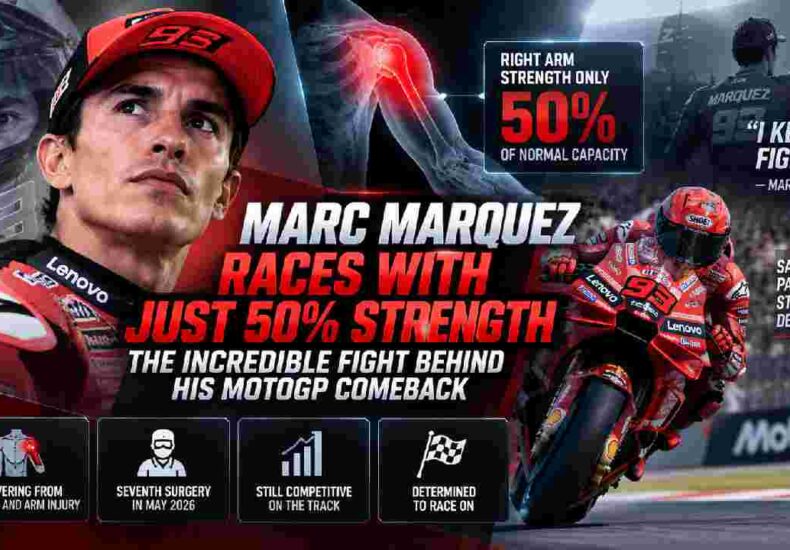
Marc Marquez Defies Physical Limits With Right Arm at Just 50 Percent Strength
Fundacion Rapala – Marc Marquez right arm strength remains at only around 50 percent of its normal capacity, yet the Ducati rider continues to compete at MotoGP’s highest level. The condition reflects the lasting effects of the serious shoulder and arm injury he suffered after an accident at the 2025 Indonesian MotoGP. According to surgeon Samuel Antuna, Marquez still needs to adapt his riding style because his right arm has not fully recovered. However, the physical limitation has not erased his competitive instinct. Every hard braking zone, rapid direction change, and acceleration places significant demands on a MotoGP rider’s upper body. For Marquez, those movements now require careful physical management. His ability to remain competitive therefore tells a deeper story than race results alone. Behind the speed lies a long rehabilitation process, repeated medical treatment, and the determination to keep racing despite a body that still cannot perform exactly as it once did.
The Indonesian MotoGP Crash Left a Lasting Physical Impact
The latest chapter in Marquez’s physical struggle traces back to the 2025 Indonesian MotoGP, where an incident involving Marco Bezzecchi caused a complex injury to his right shoulder. Although recovery followed, the effects did not simply disappear. Problems resurfaced during the 2026 MotoGP season and began affecting Marquez’s control of the motorcycle. At certain moments, his right arm could no longer respond normally. That problem was especially worrying because riders depend heavily on precise arm movement when braking, steering, and controlling a powerful MotoGP machine. What initially looked like another difficult stage in Marquez’s injury history eventually required deeper medical investigation. Doctors discovered that the issue involved more than muscle weakness. A physical obstruction was affecting a nerve responsible for important movement in his arm. For a rider already accustomed to fighting through injuries, the discovery provided an explanation for some frightening moments he experienced on track earlier in the season.
Read More : Former Heerenveen Boss
Nerve Problems Caused Marquez to Lose Control While Riding
Samuel Antuna revealed that Marquez experienced a serious nerve problem that could cause him to lose control of his right arm in specific riding positions. Medical examinations identified a section of bone pressing against the radial nerve when his arm moved into certain angles. The issue became particularly dangerous during racing and training because those positions could occur naturally while controlling the motorcycle. According to Antuna, Marquez could effectively lose command of the arm when the nerve became compressed. That helped explain several crashes earlier in the season. The problem highlights how small anatomical changes can have enormous consequences in MotoGP, where riders make rapid movements while travelling at extreme speeds. Marquez could still feel physically prepared before entering the track, yet one particular movement could suddenly compromise his control. Understanding the cause was therefore crucial. Once doctors identified the compression, they could develop a surgical plan aimed at removing the source rather than simply managing its symptoms.
A Seventh Operation Became Another Major Test
In May 2026, Marquez underwent another operation to address the persistent problem in his right shoulder and arm. The procedure became the seventh major surgical chapter in a long medical journey that has repeatedly tested his career. During the operation, doctors removed the bone fragment that had been pressing against the radial nerve. They also removed several screws from the affected area. The procedure produced encouraging results because the nerve-related problem improved afterward. Still, surgery could not immediately restore all the strength that Marquez had lost. Rehabilitation remained necessary as muscles and surrounding structures adjusted again. For an elite rider, that process involves more than simply regaining everyday movement. Marquez needs enough strength, stability, and endurance to control a MotoGP bike under severe braking and acceleration forces. Each stage of recovery therefore carries a demanding target. The operation removed an important obstacle, but rebuilding his physical capacity became the next challenge in an already extraordinary comeback story.
Read More : Marco Bezzecchi Reveals Terrifyin
Only 50 Percent Strength Changes the Way He Must Compete
Although the nerve compression has been addressed, Antuna said Marquez’s right arm currently produces only about half of its normal strength. That figure offers important context when watching him wrestle a Ducati around a circuit. MotoGP demands repeated heavy braking, fast transitions, and constant corrections through the handlebars. Therefore, weakness in one arm can affect balance, endurance, and precision throughout a race. Marquez has had to adapt rather than wait for perfect physical condition. His experience allows him to understand where he can compensate through technique, body position, and timing. However, adaptation does not eliminate the physical challenge. Fatigue can become increasingly important as laps accumulate, especially on circuits with several demanding braking zones. The remarkable part of his current situation is not simply that he continues riding. Instead, it is that he remains capable of fighting at a competitive level while managing a measurable physical disadvantage that would significantly affect almost any professional athlete.
Aragon Showed the Competitive Fire Is Still Burning
Marquez’s performance at MotorLand Aragon offered a striking contrast to the medical reality surrounding his right arm. Despite the lingering weakness, the Ducati rider delivered competitive performances and celebrated success during the race weekend. Those scenes carried greater meaning when viewed alongside the details of his rehabilitation. From the outside, a rider standing on a podium can appear fully recovered. Yet Marquez’s situation shows how elite athletes may continue competing while managing limitations that remain largely invisible to spectators. His speed comes from more than raw physical strength. Experience, race intelligence, braking judgment, body positioning, and an intimate understanding of motorcycle behavior all contribute to his performance. Nevertheless, physical strength still matters, particularly over race distance. Every successful weekend therefore represents another test of how effectively he can manage his condition. Aragon did not erase the injury, but it demonstrated that the limitations of his right arm have not removed the aggressive competitive spirit that has defined his MotoGP career.
Recovery Remains Part of Marquez’s Fight for the Future
Marquez’s medical journey is not finished simply because surgery resolved the nerve compression. Recovering strength remains an important part of his ongoing rehabilitation, especially while he continues competing through a demanding MotoGP calendar. His situation also underlines why medical supervision matters after complex injuries. Returning to competition does not always mean an athlete has returned to full physical capacity. For Marquez, progress now involves balancing performance with the long-term condition of his shoulder and arm. The encouraging element is that doctors identified and treated the mechanical cause behind his sudden loss of control. However, restoring strength takes time, structured rehabilitation, and careful evaluation. Marquez has already spent years learning how to race around physical setbacks, but this challenge demands another level of adaptation. His story now extends beyond victories and championship points. Each race also measures how far his body has recovered and how much determination can compensate for the strength it has yet to regain.