The Megastructure Built for Eternity and Still Standing 1,700 Years Later
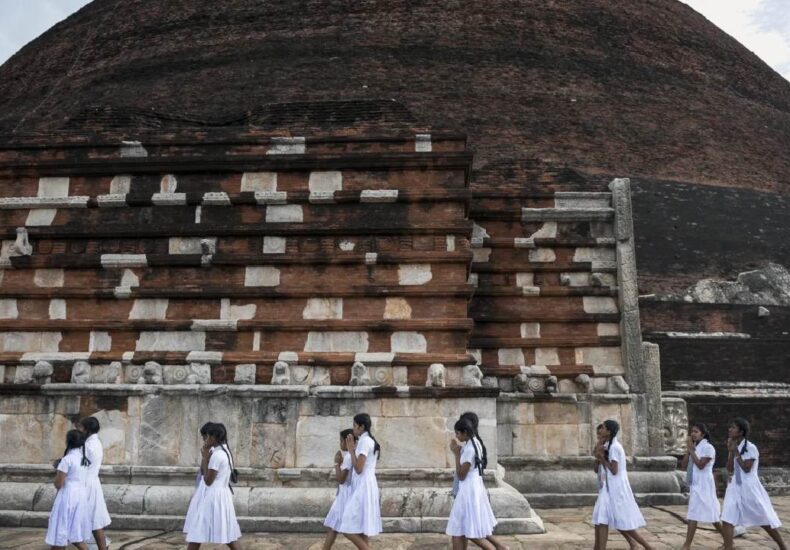
Fundacion Rapala – Jetavanaramaya doesn’t behave like a ruin. On a full moon day in Anuradhapura, pilgrims in white walk barefoot along dusty paths. At dawn, saffron-robed monks chant as incense drifts through the air. Meanwhile, visitors from Taiwan, Canada, and beyond join rituals that have continued for more than 2,000 years. Because of that continuity, the site feels alive rather than preserved. Anuradhapura, Sri Lanka’s first great capital, remains one of the most sacred Buddhist cities on Earth. Even if you arrive as a curious traveler, the atmosphere changes you. You lower your voice. You slow your steps. And you begin to understand that this place was built to shape human attention, not just to impress the eye.
Anuradhapura Was Designed as a Sacred Megacity, Not a Tourist Landmark
Anuradhapura stretches across Sri Lanka’s north-central plains like a spiritual blueprint. Instead of one monument, you encounter an entire ecosystem of monasteries, reservoirs, and stupas. As a result, Jetavanaramaya rises as the centerpiece of a larger religious world. The city also holds historic weight because it became one of the first places outside India to adopt Buddhism. That detail gives the site a global religious identity, not only a national one. In my view, this is what makes Anuradhapura so rare. The ancient builders didn’t create a single sacred building and stop there. They built a complete environment that trained the mind through daily movement. Consequently, modern visitors don’t just “see” history here. They feel how a civilization once organized belief, labor, and meaning.
Jetavanaramaya Once Ranked Among the Largest Buildings on Earth
When Jetavanaramaya reached completion around 301 CE, it ranked as the third-largest man-made structure on Earth. Only the Great Pyramids of Giza surpassed it in scale. At its original height, the stupa rose about 122 meters, making it one of the tallest structures of the ancient world. Today, it stands around 71 meters after centuries of collapse and restoration. Even so, it still dominates the landscape. More importantly, Jetavanaramaya remains the largest brick structure by volume ever constructed. That single fact separates it from most ancient wonders. Stone pyramids impress through mass. Jetavanaramaya impresses through repetition, precision, and the discipline required to stack millions of fragile units into one stable form.
Ninety-Three Million Bricks Explain the Madness and the Genius
Jetavanaramaya required an estimated 93.3 million baked mud bricks. That number sounds abstract until you picture the work behind it. Workers had to shape bricks, fire them, transport them, and lay them with consistent alignment. Because brick erodes more easily than stone, builders also needed smart mortar and careful structural planning. In other words, they didn’t simply build large. They built intelligently at scale. Archaeologists often describe the volume with comparisons to long walls stretching between distant cities. Those images help, but they still fail to capture the human effort. In my opinion, the most astonishing part is not the height. The real miracle is the coordination. A project like this demanded supply chains, skilled labor, and leadership that could hold a vision steady for years.
A Monastic World Revolved Around One Sacred Center
Jetavanaramaya refers not only to the stupa, but also to the wider monastic complex called Jetavana Vihara. The complex once housed hundreds of monks and oriented every structure toward the stupa. As monks stepped outside, they faced the monument first, which turned architecture into daily devotion. The terraces at the base also played an important role. People once brought robes, books, and food as offerings to gain merit. So, the site functioned as a living city, not a silent shrine. This design created a constant loop of support. Laypeople sustained monks, monks sustained religious practice, and Jetavanaramaya anchored the entire system. That social structure helps explain why the monument still matters today. It was never built only for spectacle. It was built for continuity.
“Read More : Missed the Big 2025 Stock Market Rally? It’s Not Too Late to Invest Internationally”
Controversy Followed the Monument from the Very Beginning
Jetavanaramaya did not rise in perfect harmony. Ancient sources describe tensions around its construction, since the stupa stood on land linked to the Maha Vihara, associated with orthodox Theravada Buddhism. Later, the complex became connected to a sect that leaned toward Mahayana doctrines. Unfortunately, many Mahayana chronicles from ancient Sri Lanka did not survive. Because of that loss, historians must reconstruct parts of Jetavanaramaya’s story indirectly. That uncertainty creates debate, but it also adds realism. Sacred monuments often reflect politics as much as belief. In my view, the controversy makes the stupa even more compelling. It proves that this structure was not only spiritual. It also represented power, ideology, and competing visions of religious authority.
Ancient Engineers Had to Defeat Monsoons, Weight, and Time
Jetavanaramaya showcases advanced engineering for its era. The massive hemispherical form distributes weight efficiently, which helps prevent structural failure. Ancient chronicles also describe builders flooding excavated ground to observe absorption, a simple but effective form of soil testing. These details suggest a strong understanding of foundations. Still, nature challenged the monument for centuries. Monsoon rains, earthquakes, and abandonment caused major sections to collapse. The stupa’s reduced height tells that story clearly. Later restorations introduced cement into some outer layers, and experts now suspect this choice may have harmed the structure rather than protected it. That lesson feels surprisingly modern. Preservation requires humility. Sometimes the original materials work better because they match the climate and the building’s natural “breathing” patterns.
Sacred Relics and Gold Panels Reveal a Cosmopolitan Buddhist Past
Jetavanaramaya was not an empty shell. Builders embedded reliquary caskets throughout the stupa at different structural levels. These deposits turned the monument into a sacred vessel built from the inside out. Excavations also uncovered gold panels depicting Bodhisattva imagery and inscribed with passages connected to the Prajñāpāramitā tradition. Scholars believe these artifacts offer rare evidence of Mahayana influence in ancient Sri Lanka. Today, the National Museum in Colombo preserves many of these discoveries. This material evidence suggests Jetavana once acted as a cosmopolitan center of Buddhist thought. Trade routes across the Indian Ocean likely carried ideas, texts, and artistic styles into the region. In my opinion, this layer of the story changes everything. Jetavanaramaya wasn’t only a Sri Lankan wonder. It was part of a wider intellectual world.
The Spire’s Mystery Keeps the Monument Alive in the Imagination
Even after 1,700 years, Jetavanaramaya refuses to become fully knowable. The damaged spire still raises questions about how it once looked. Historical accounts suggest a diamond may have crowned the pinnacle, perhaps as symbolism and perhaps to deflect lightning during monsoon storms. The spire’s tower-like form also stands out compared to many other stupas. Some scholars suspect it reflects distant influence carried through trade networks. At the base, small remnants of decorative motifs remain, including Naga-inspired cobra forms. Yet researchers still debate how artisans fixed these details into place. That mystery gives the stupa emotional power. You don’t just admire what survived. You also wonder what disappeared. And in that space between knowledge and silence, Jetavanaramaya continues to feel eternal.