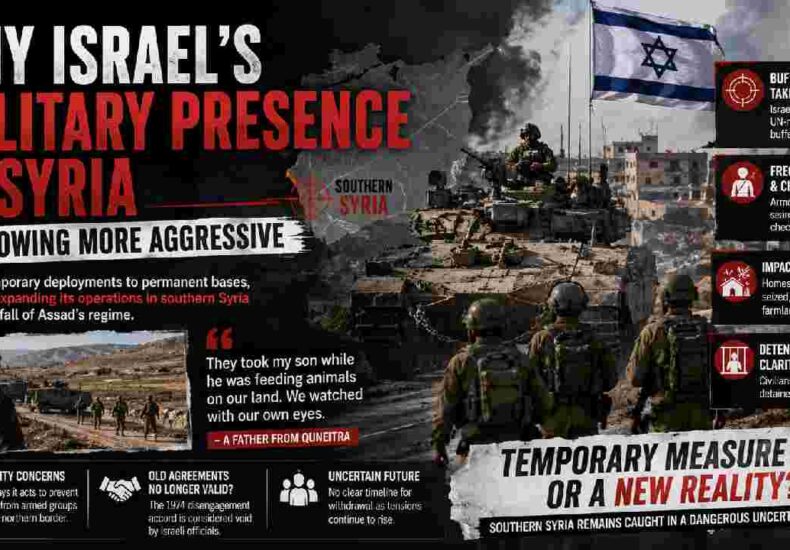
Why Israel’s Military Presence in Syria Is Growing More Aggressive
Fundacion Rapala – Israel’s military presence in Syria has become a growing concern for communities near the occupied Golan Heights. What once appeared to be a temporary security measure now looks increasingly long-term. Israeli forces have expanded operations across parts of southern Syria, particularly in Quneitra and Daraa. The situation changed significantly after the fall of Bashar al-Assad’s government in December 2024. Israel then moved troops into a demilitarized buffer zone that the United Nations had monitored for decades. Israeli officials argued that the move was necessary to protect the border from potential threats. However, local residents have since reported frequent patrols, checkpoints, searches, and raids. As a result, Israel military presence Syria has become more than a border-security issue. For many Syrians living nearby, it now affects movement, farmland, livelihoods, and everyday life.
A Syrian Family Still Waiting for Their Son
Behind the military developments are families dealing with painful uncertainty. Ahmad Hassan al-Din says Israeli soldiers took his teenage son, Saddam, from farmland near the Golan Heights in April 2024. According to the father, Saddam had gone out early that morning to feed animals. The family later watched soldiers lead him away in restraints. Al-Din insists his son had permission to work in the area through arrangements connected with United Nations monitoring. Humanitarian groups later indicated that Saddam may have been held inside Israel. Yet his family has continued searching for clear answers about his legal situation. The case illustrates the human impact of growing tensions along the border. Military strategy can often appear distant when viewed through maps and official statements. However, for families in southern Syria, every new patrol or detention can bring fear directly to their doorstep.
Read More : China’s Global Image Rises as Perceptions of the US Shift
Why the Buffer Zone Has Become So Important
The buffer zone between Syria and the Israeli-controlled Golan Heights dates back to the 1974 disengagement agreement. For decades, the United Nations Disengagement Observer Force monitored the area and helped keep the opposing militaries apart. Political upheaval in Syria later changed that balance. Following Assad’s fall, Israeli officials argued that the old security arrangement could no longer provide sufficient protection. Israeli troops subsequently moved deeper into the zone. Israel described the deployment as a defensive response to uncertainty across the border. However, the construction of military positions has raised questions about how temporary that deployment really is. UN observers reported multiple Israeli bases in the area by late 2025. Therefore, the debate now extends beyond immediate border protection. The central question is whether Israel intends to withdraw when conditions stabilize or maintain a lasting security presence inside Syrian territory.
Raids and Checkpoints Reshape Everyday Life
Residents of southern Syria have increasingly reported Israeli military activity beyond established positions. Armored patrols have entered populated areas in Quneitra and Daraa, while temporary checkpoints have appeared on important roads. According to local reports, soldiers have stopped civilians, questioned travelers, searched belongings, and inspected mobile phones. Some accounts also describe raids on homes and businesses. These operations have changed daily routines for people who already endured years of conflict and economic hardship. Farmers face particular challenges because access to fields and water sources can determine whether a family earns enough to survive. Local authorities have also accused Israeli forces of damaging agricultural land and water infrastructure. Israel says its actions focus on security threats near its northern border. Still, the expanding military footprint has created uncertainty among Syrians who fear that temporary security operations could gradually become permanent.
Read More :Turkey and Israel Trade Sharp Accusations as Netanyahu
Security Concerns Drive Israel’s Strategy
Israel views southern Syria through the lens of national security. The area sits close to the Golan Heights, which Israel captured from Syria during the 1967 Arab-Israeli War and later annexed. Syria continues to regard the territory as occupied land. Israeli leaders have repeatedly argued that instability across the border could allow hostile armed groups to establish positions near Israeli communities. From that perspective, controlling strategic areas can create additional distance between potential threats and the border. Yet this strategy carries significant political and humanitarian consequences. A wider military presence can increase tensions with Syrian communities and complicate diplomatic efforts involving regional powers. It can also create new disputes over sovereignty. Therefore, Israel faces a difficult calculation. Greater territorial control may offer short-term security advantages, but prolonged operations could create resentment and instability that generate new security problems over time.
Syrian Civilians Face an Uncertain Future
For civilians in Quneitra and surrounding areas, uncertainty remains the most difficult part of the crisis. Many residents do not know how long Israeli forces will remain or whether military operations will expand further. Families must continue working, farming, and traveling while adapting to checkpoints and changing security conditions. Meanwhile, damaged infrastructure can make ordinary life even harder. Communities in southern Syria already carry the scars of a prolonged civil war. A new period of military tension adds another burden to people who hoped political change might finally bring greater stability. The future will depend partly on regional diplomacy and the ability of international institutions to maintain workable security arrangements. Until then, Israel military presence Syria will remain a sensitive issue. Beyond military calculations and political statements, its consequences continue to unfold in the daily lives of ordinary people.
A Temporary Deployment or a Lasting Shift?
The most important question now concerns what happens next. Israel initially framed its expanded presence as a response to the security vacuum created by political upheaval in Syria. However, military bases, regular patrols, and continuing operations can make a short-term deployment look increasingly permanent. Any prolonged presence could further strain relations with Syria and attract stronger regional opposition. At the same time, Israel is unlikely to reduce its security posture without guarantees that hostile forces will stay away from its border. That leaves southern Syria caught between competing security priorities and unresolved territorial disputes. Diplomacy may eventually provide a path toward a new border arrangement. Yet reaching such an agreement will require trust that remains scarce across the region. Until a durable framework emerges, communities near the Golan Heights will continue living with a military reality that appears increasingly difficult to reverse.