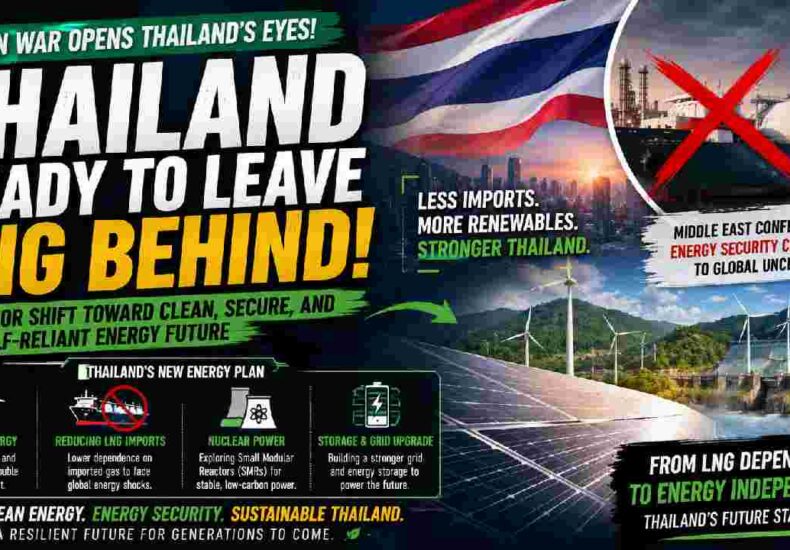
Thailand Rethinks LNG Dependence as Iran War Reshapes Energy Strategy
Fundacion Rapala – The Thailand Clean Energy Transition is gaining urgency as instability in the Middle East exposes the country’s dependence on imported fuel. Thailand currently relies heavily on natural gas to generate electricity. Much of that supply comes from imports, including liquefied natural gas transported by sea. Therefore, geopolitical conflict can quickly affect domestic energy costs. Energy Minister Akanat Promphan said the Iran war showed why Thailand needs a cleaner and more independent power system. Rather than abandoning gas overnight, Bangkok wants to gradually reduce its reliance on imported LNG and other fuels. The shift reflects more than environmental ambition. It has become an issue of economic security and national resilience. For households and businesses, volatile fuel prices can translate into higher electricity bills. As a result, Thailand now sees renewable energy as both a climate solution and protection against unpredictable global shocks.
Clean Electricity Target Rises to 60 Percent
Thailand now plans to generate 60 percent of its electricity from clean sources within the next 25 years. Solar, wind, and hydropower will play central roles in that transformation. The new ambition is roughly twice the country’s earlier target. Moreover, the government expects to formally include it in an updated 25-year national energy plan scheduled for October. This shift signals a significant change in how policymakers view energy security. Renewable power was once discussed mainly through the lens of emissions. Today, officials also see it as a way to reduce exposure to international fuel markets. Thailand currently gets only around 15 percent of its energy mix from renewable sources. Reaching the new target will therefore require major investment, stronger electricity networks, and better energy storage. Even so, policymakers believe the cost of maintaining excessive dependence on imported fuel could become much greater.
Read More : Deadly Nepal Flash Floods Lea
Heavy Gas Dependence Creates an Economic Risk
Natural gas currently produces more than 60 percent of Thailand’s electricity, according to the figures cited in the report. That dependence has supported the country’s development for years, yet it also creates a clear weakness. When LNG prices rise because of war or supply disruption, Thailand has limited room to escape the impact. Imported fuel costs can eventually reach factories, businesses, and ordinary families through electricity prices. Consequently, reducing LNG dependence could strengthen Thailand’s ability to manage future crises. The challenge, however, lies in maintaining reliable power while changing the energy mix. Solar and wind generation can fluctuate with weather conditions. Thailand will therefore need storage systems, stronger transmission infrastructure, and dependable backup generation. The transition must balance affordability, reliability, and environmental goals. If managed carefully, a more diverse energy system could provide the country with valuable protection from global price swings.
Data Centers Add Pressure to Thailand’s Power Grid
Thailand’s energy transformation is happening as electricity demand is expected to climb sharply. The country has attracted billions of dollars in investment linked to data centers, cloud computing, and advanced manufacturing. These industries can consume enormous amounts of electricity around the clock. Therefore, the government faces two challenges at once: reducing dependence on imported fossil fuels while supplying enough power for a growing digital economy. Akanat warned that the next investment wave will require substantial electricity capacity. This makes long-term planning increasingly important. Renewable projects must expand quickly, but the power grid must also become capable of handling variable generation and new industrial demand. Meanwhile, policymakers want to limit pressure on household electricity bills. The stakes are high because unreliable or expensive electricity could weaken Thailand’s appeal to international investors. Energy policy is consequently becoming closely connected to the country’s future economic competitiveness.
Read More :Germany’s Toxic Time Bomb: Old
Nuclear Power Enters Thailand’s Long-Term Strategy
One of the biggest changes in Thailand’s proposed energy strategy is the inclusion of nuclear power. The government has been studying small modular reactors, often called SMRs, as a possible source of stable, low-carbon electricity. Unlike solar panels or wind turbines, nuclear reactors can provide continuous power regardless of weather conditions. That reliability could help support a grid with a growing share of renewable energy. However, nuclear development also brings difficult questions about safety, costs, regulation, waste management, and public acceptance. Thailand will need transparent planning if the proposal advances beyond preliminary studies. Still, including nuclear power shows how seriously policymakers are reconsidering the country’s energy structure. Rather than relying heavily on one imported fuel, officials appear interested in a broader mix of technologies. Such diversification could become particularly valuable as geopolitical uncertainty and electricity demand continue to reshape energy markets across Asia.
Renewable Investment Reaches Communities and Rooftops
Thailand’s government has defended plans to spend about 200 billion baht on renewable energy development. Part of that investment would support rooftop solar systems in villages, bringing the transition closer to communities rather than concentrating projects only in large power plants. Distributed solar generation could help households and local areas produce some electricity near where they use it. In addition, wider renewable adoption may reduce pressure on imported fuel demand over time. Yet investment alone will not guarantee success. Thailand will need clear regulations, accessible financing, grid upgrades, and systems that allow smaller producers to participate effectively. Communities also need confidence that new projects will provide practical benefits. If those elements come together, renewable expansion could become more than a response to international conflict. It could reshape how electricity is generated and consumed across the country while creating new economic opportunities beyond major urban and industrial centers.
A New Energy Era Driven by Security and Climate Goals
Thailand last revised its 25-year power development strategy in 2023, before the latest geopolitical shocks and the rapid expansion of artificial intelligence infrastructure. The world surrounding that plan has changed dramatically. Energy security, climate commitments, digital investment, and global conflicts now overlap in ways policymakers cannot easily separate. Thailand aims to reach net-zero emissions by 2050, but its latest direction shows that decarbonization is no longer the only motivation. Reducing dependence on imported LNG could also give the country greater control over electricity costs and future supply risks. Still, moving toward cleaner energy will take decades rather than months. Gas will likely remain important during the transition. What has changed is the direction of travel. The Iran war appears to have strengthened Bangkok’s determination to diversify its power system and build an energy future that depends less on events occurring thousands of kilometers away.