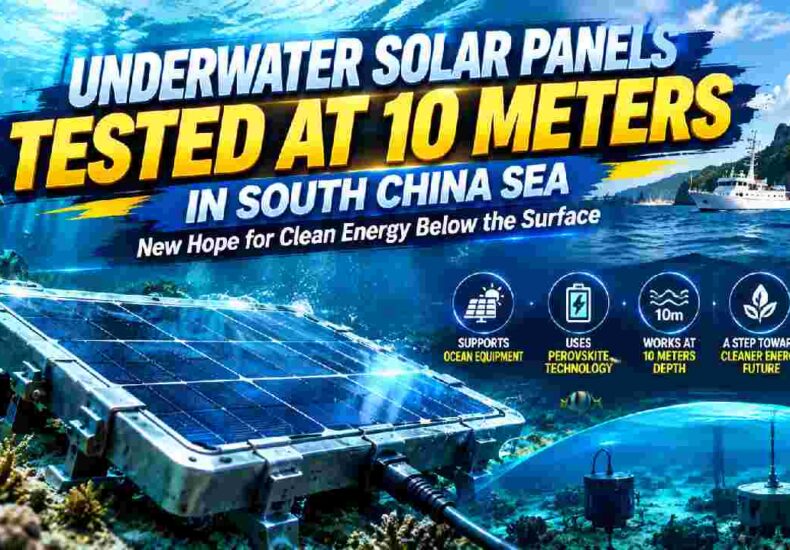
Scientists Test Solar Panels 10 Meters Underwater in South China Sea
Fundacion Rapala – The South China Sea has become the setting for an unusual energy experiment. Scientists have successfully tested solar panels beneath the ocean surface at a depth of 10 meters. The field trial near Weizhou Island shows that solar technology can still generate electricity underwater, even when sunlight becomes much weaker. Previously, most research focused on shallow water, usually at depths of two meters or less. This new test pushes the technology much further. The researchers believe the approach could eventually provide power for underwater sensors, cameras, communication devices, and other equipment. As a result, marine technology may gain a new energy option that reduces the need for frequent battery replacement. The study, published in Joule, also highlights how new solar materials could help engineers capture the limited light that reaches deeper parts of the ocean.
Scientists Take Solar Power Beneath the Ocean
At first glance, placing solar panels underwater may seem impractical. Sunlight loses intensity as it travels through water, while deeper areas receive far less usable light. However, the research team found a way to work with the light that remains. Scientists from Yunnan University and Southwest United Graduate School designed solar cells that can capture blue and green wavelengths. These colors travel farther through seawater than many other parts of the visible spectrum. Therefore, the researchers could target the wavelengths that still reach the panel at greater depths. Wen-Hua Zhang, one of the study authors, described the field trial as an important step for underwater solar technology. The experiment did more than show that the cells could produce electricity in a laboratory. Instead, it demonstrated that the technology could function under real marine conditions at a depth of around 10 meters.
Read More : Flydubai Flight Plunges After Cockpit Attack, Lands Safely in Saudi Arabia
Perovskite Material Plays a Key Role
The researchers relied on perovskite solar technology rather than conventional silicon cells. Perovskite materials can offer useful flexibility when engineers need to tune a solar cell for specific light conditions. In this experiment, that feature became particularly important because seawater filters sunlight as it moves deeper. During laboratory tests, the perovskite cells converted about 35 percent of the available light into electrical energy under simulated conditions at 10 meters. That result gave the researchers a strong basis for their field trial. More importantly, the material allowed the team to focus on the blue and green light that could still penetrate the water. Consequently, the solar cells continued producing power even after the panel moved several meters below the surface. The approach shows how material science can change the way engineers think about renewable energy in unusual environments.
Field Testing Produces Measurable Power
The real test took place in the South China Sea near Weizhou Island. Researchers used a solar panel measuring about 115 square centimeters and operated it for two hours at different depths. At two meters underwater, the panel generated 1,416 milliwatt-hours of energy. That amount equals roughly half the capacity of a rechargeable AA battery. At 10 meters, production fell to 324 milliwatt-hours during the test period. Although the output dropped with depth, the panel still generated usable electricity. This result matters because underwater equipment often requires relatively modest amounts of power. Sensors, monitoring cameras, and communication devices do not always need the same energy levels as household appliances. Therefore, even limited solar generation could help extend operating times and reduce the need for crews to replace batteries in remote marine locations.
Read More : Extreme Roller Coaster in the US Raises Concerns After Passengers Suffer Brain Injuries
The Technology Shows Strong Durability
Power generation was not the only factor that caught the researchers’ attention. The underwater solar cells also demonstrated strong durability during extended laboratory simulations. The team tested the technology for 1,160 hours under underwater conditions and observed almost no decline in performance. Based on those results, the researchers estimated that the panel could potentially operate continuously at a depth of 10 meters for around five and a half years. However, that estimate remains a projection rather than a confirmed service life in the open ocean. Real marine environments can introduce challenges such as saltwater exposure, biological growth, waves, pressure changes, and physical damage. Even so, the long laboratory test provides useful evidence about the material’s stability. In turn, this durability could become an important factor if engineers eventually develop larger underwater solar systems for long-term marine applications.
Underwater Solar Could Support Ocean Equipment
The technology could eventually serve several types of equipment that operate far from shore. Ocean sensors, underwater cameras, communication systems, and monitoring devices often require reliable power for long periods. Traditionally, many of these systems rely on batteries that crews must replace or recharge. That process can increase maintenance costs and require vessels to travel to remote locations. Underwater solar power could reduce some of those challenges by providing a continuous source of energy during daylight hours. Furthermore, combining solar generation with energy storage could help equipment continue operating when light levels change. The system could prove especially useful for scientific research, environmental monitoring, and offshore infrastructure. However, engineers still need to examine how the panels perform under stronger currents, deeper water, and longer exposure to seawater. Those tests will help determine which applications make the most practical sense.
Researchers Plan Deeper Ocean Tests
The successful 10-meter trial does not mark the end of the project. Instead, it gives researchers a starting point for exploring how far solar technology can work below the surface. The team plans to conduct additional tests at greater depths and examine how light conditions affect energy production. Deeper water will create new challenges because sunlight becomes weaker with every meter. Engineers will also need to consider pressure, temperature, corrosion, marine organisms, and installation costs. Even so, the current results open an interesting path for renewable energy research. If future experiments maintain useful power output at greater depths, underwater solar panels could become part of a broader off-grid energy system. For now, the 10-meter demonstration provides an important glimpse of how solar technology might move beyond rooftops and open land to serve machines working beneath the waves.