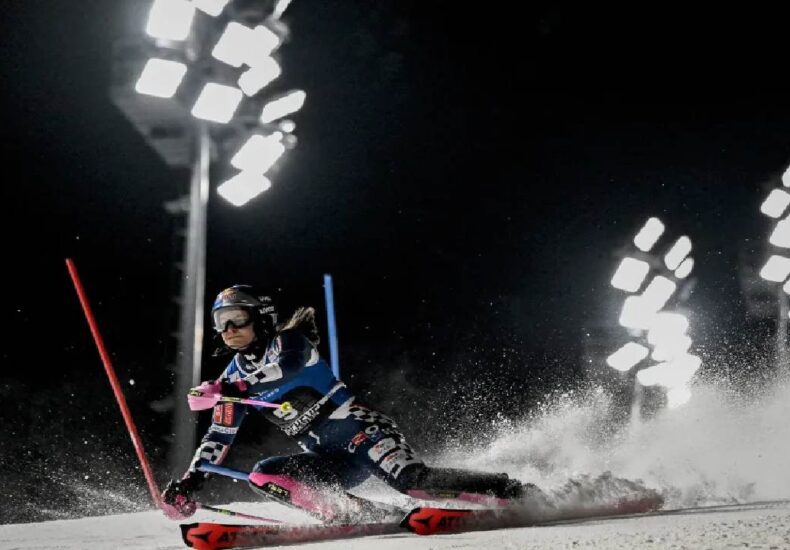
Mikaela Shiffrin Redefines Dominance With Historic 105th World Cup Slalom Win
Fundacion Rapala – Courchevel delivered cold air, bright lights, and a familiar outcome as Mikaela Shiffrin once again stood alone at the top of the leaderboard. From the opening run, she skied with a calm authority that felt almost routine, yet anything but ordinary. The American star did not chase the moment; she controlled it. As rivals struggled with the demanding course, Shiffrin increased her advantage with each precise turn. By the time she crossed the finish line, the margin told its own story. Winning by more than 1.5 seconds in slalom is rare. Doing it repeatedly turns excellence into expectation. In that French alpine night, Shiffrin made history feel quiet, composed, and unstoppable, extending her World Cup record to an astonishing 105 victories.
Winning by Margins That Redefine the Sport
In alpine skiing, time gaps often come down to hundredths of a second. Shiffrin operates on a different scale. This season, she has won every slalom by more than a full second, with several victories stretching far beyond that mark. Her average winning margin now sits at just over 1.5 seconds, a figure that feels almost unreal in elite competition. These are not lucky runs or chaotic races. They are controlled performances built on precision, confidence, and relentless focus. Each gate looks measured, each line intentional. When Shiffrin skis, she does not simply beat her rivals. She separates from them. The margins speak loudly, even when she lets her skis do most of the talking.
“Read More : Lawmakers Await Epstein Files as Trump Administration Faces a Defining Moment”
Consistency That Builds Pressure on the Field
Shiffrin’s dominance this season has reshaped the emotional landscape of women’s slalom racing. She has now won five straight slaloms, dating back to the end of last season, and four to open the current campaign. For competitors, that kind of consistency creates pressure before the race even begins. Mistakes feel heavier. Risks feel sharper. Several top challengers pushed hard in Courchevel, and the course punished them. Lena Dürr skied out early. Lara Colturi lost her chance before the final gates. Others never reached the finish. While racing always carries risk, Shiffrin’s steady presence at the top raises the stakes for everyone chasing her, turning each run into both a technical and mental test.
Moments of Drama Behind the Leader
While Shiffrin delivered control, the race behind her unfolded with tension and uncertainty. Wendy Holdener provided one of the most alarming moments of the night after hitting a hole near the finish and flipping onto her back. The crowd held its breath as she lay still, then slowly stood and skied again. Defending slalom champion Zrinka Ljutić failed to finish for the third straight race, highlighting how unforgiving the discipline can be. Katharina Liensberger also exited early, adding to a list of big names undone by small errors. Against this backdrop of chaos, Shiffrin’s clean, confident skiing stood out even more, like a steady heartbeat in a race full of sudden stops.
“Read More : Steelers Turn Monday Night Into a Fortress With Win Over Dolphins”
A Career Built on Reinvention and Resilience
Shiffrin’s 68th career World Cup slalom win adds another chapter to a journey defined by growth and adaptation. She captured Olympic gold in slalom in 2014, then reinvented herself to win giant slalom gold in 2018. Her career has not followed a straight line. The disappointment of leaving the 2022 Beijing Olympics without a medal tested her resolve. Yet she returned stronger, calmer, and more complete. Each season now feels less about proving something and more about mastering the moment. Shiffrin skis with the awareness of someone who understands both victory and loss, and that balance shows in every run she completes.
Eyes Turning Toward Cortina and Olympic History
With the next Winter Olympics set for Cortina d’Ampezzo, Shiffrin’s form invites quiet anticipation. The Italian resort holds powerful memories, where she once won four medals at the world championships. It is also where Lindsey Vonn set a record with 12 World Cup victories. History lingers on those slopes, and Shiffrin knows it well. Right now, she is not chasing comparisons or counting medals. She is skiing freely, pushing without hesitation, and trusting the rhythm she has built. If Courchevel offered a glimpse of what lies ahead, the rest of the field understands one thing clearly: Mikaela Shiffrin is not slowing down.